Search Bar

Custom Search

search results

Tuesday, February 18, 2014

American Women Competing in 2014 Winter Olympics Giant Slalom Event

The Women's Giant Slalom race took place to day (February 18, 2014) at the Winter Olympics in Sochi.

Five American women alpine skiers competed with four of them members of Team USA the official team of America's National Olympic Committee (NOC) with the fifth skier, Jasmine Campbell, skiing for Team U.S. Virgin Islands.
Alpine Skier
Source: Public Domain Graphic from WikiMedia Commons

While the 22 year old Ms Campbell is an American citizen who was born in the U.S. Virgin Islands territory and has lived in Idaho since her family moved there when she was nine years old she is actually representing a the U.S. Virgin Islands which, as a non-self-governing territory is entitled to have its own National Olympic Committee and field its own teams in both the Winter and Summer Olympics.

While none of the American women skiers qualified for medals in the Giant Slalom four of them did successfully complete the event by making the two required runs down the course successfully.  The fifth American skier, Julia Marie Mancuso, was among the 27 skiers who encountered problems on the course and were unable to complete the event.

The other four finished as follows:


For more on skier Jasmine Campbell and the U.S. Virgin Islands team for the 2014 Winter Olympics in Sochi, Russia click here.


Monday, November 11, 2013

Veterans Day 2013 - Remembering Vietnam War Aviators

U.S. air power played a major role in the Vietnam war.  Like previous wars, aviation played a supporting role for the infantrymen on the the ground who actually took and held the real estate needed to win a war.

However, it was air strikes which helped force enemy forces back when they threatened to over run a ground position.  Fighters and bombers also carried out both strategic and tactical attacks against enemy movements and supply depots and helicopters supplied munitions and other supplies as well as reinforcements to troops in the field.

F-4 Phantom Jet on Display at Davis-Monthan AFB in Tucson, AZ
F-4 Phantom Jet flown by Triple ACE and Red River Fighter Pilots Association founder, Col. Robin Olds in Vietnam War (Photo copyright by Chuck Nugent)
As in all wars, prisoners were taken and in the Vietnam War the majority of the American POWs (Prisoners of War) were aviators whose planes were shot down while on missions over North Vietnam, Laos and Cambodia.

Just inside the main gate of Davis-Monthan AFB in Tucson, Arizona is a small park dedicated to aviators and the planes they flew during the turbulent last half of the twentieth century.

One section of the park is dedicated to the Red River Valley Fighter Pilots Association (with the Red River Valley referring to the Hong River that flows through the old North Vietnam from the Chinese border to the Gulf of Tonkin).

The Red River Valley Fighter Pilots Association is an organization whose original membership was limited to U.S. aviators who had flown combat missions over Route Pack 6 a combat area over North Vietnam that included the port city of Haiphong and the North Vietnamese capital of Hanoi.  The air defenses in the Route Pack 6 area were the strongest in the entire combat theater.  Membership has since been opened to anyone who has flown as an aircrew member on any U.S. military aircraft.

Sculpture Honoring Vietnam POWs at Davis-Monthan AFB in Tucson, AZ
Sculpture Honoring Vietnam War POWs at Davis-Monthan AFB, Tucson, AZ  (photo copyright by Chuck Nugent)
Given the the heavy air defenses in the Route Pack 6 area and the thousands of U.S. combat missions flown in that area it is not surprising that many of the Vietnam POWs were aviators who had been shot down on missions over Route Pack 6.

For more information on the park at DMAFB and the Red River Valley Fighter Pilots Association click here


Wednesday, July 24, 2013

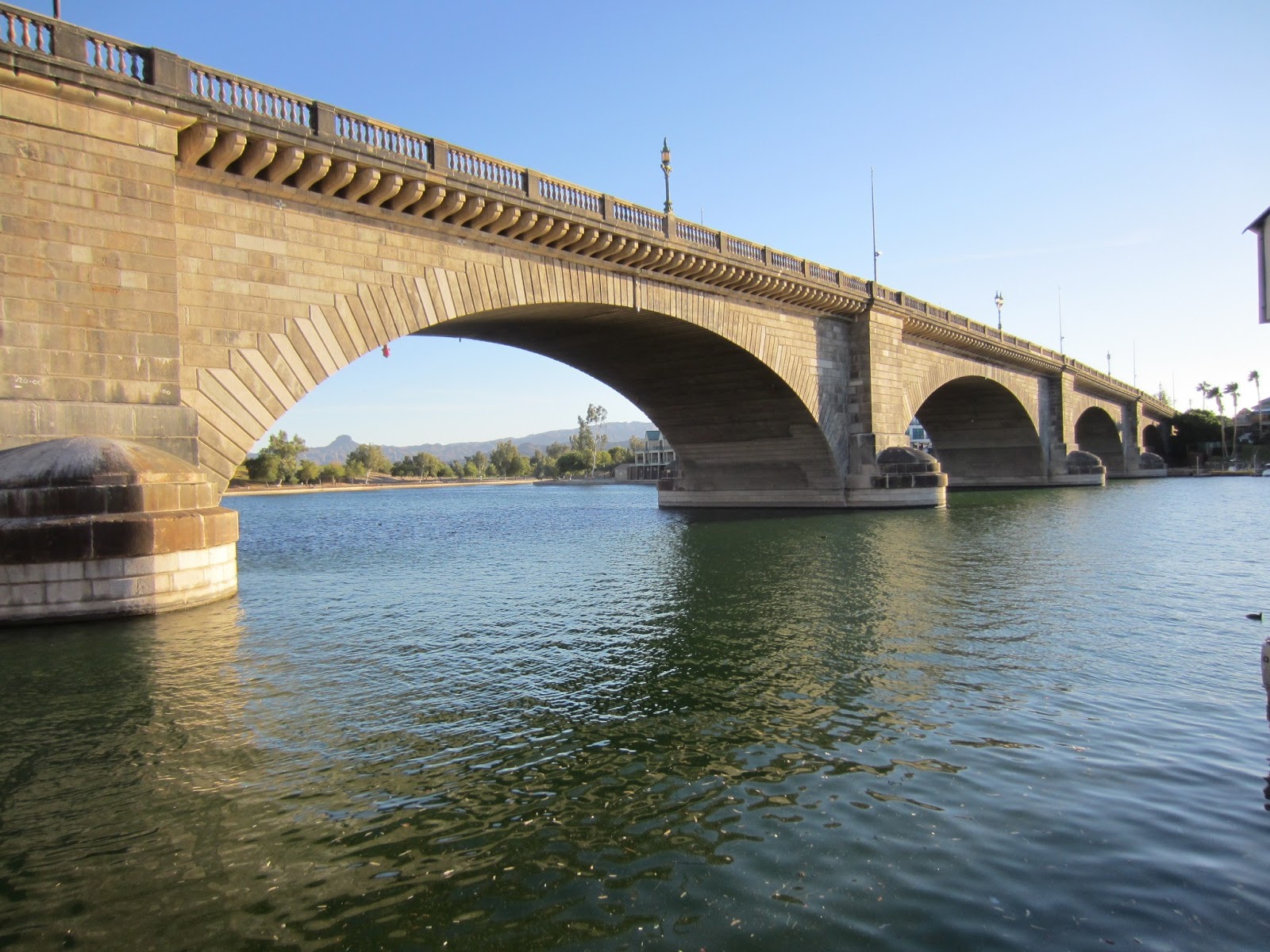
London Bridge in the Arizona Desert


The bridge was originally built across the River Thames in London, England and opened to traffic in 1831.  

The original London Bridge was built of timber and was later replaced by a stone bridge that was built between 1176 and 1209.

This masonry bridge that was started in 1176, lasted until the late eighteenth century.  Despite its having lasted over 600 years, the uneven construction of that bridge resulted in its need for regular repairs.  This may be one reason for the nursery rhyme London Bridge is Falling Down as, without the frequent repairs, it would have fallen down.

London Bridge - Lake Havasu, Arizona  
(photo Copyright © 2013 by Charles Nugent)


In addition to carrying foot and horse traffic this original stone bridge was home to many people and their shops.  With their homes and shops built on the bridge many people literally spent their lives living on the bridge.  In addition to the living, the bridge was also a place where the severed heads of prominent political prisoners and other notorious criminals were displayed.


In 1799 plans began being developed to replace the 600 year old bridge as it was not aging gracefully.  The new bridge was completed and opened in 1831.  However, by the mid-twentieth century, this bridge was straining under the heavy twentieth century London traffic.

In 1967 the London Common Council decided to sell the bridge and build a new one.  


When Robert Plumer, real estate agent for Robert P. McCulloch, the Chairman of McCulloch Oil Company and the man who was trying to develop a retirement community called Lake Havasu City located in what was then a remote area in the Arizona Desert, saw the announcement that the City of London was trying to sell the bridge and suggested to McCulloch that he purchase the bridge.  

Plumer's idea was to use the bridge in the middle of the desert as a tourist attraction to draw people to the Lake Havasu City project which, at that time, was not turning out to be a profitable venture.

Although he initially scoffed at the idea, McCulloch did reconsider and put in a bid for $2.4 million and won.  The bridge was then disassembled, stone by stone, each stone numbered and then shipped from London to Houston, Texas by ship and then overland to the Lake Havasu City project site where it was reassembled across a canal that had been built for it to span.

The gamble paid off with the publicity and uniqueness of a historic British bridge in the middle of the Arizona desert drawing tourists and retirees in droves to Lake Havasu City.  The project was a success and the profits were more than enough to cover the cost of buying, transporting and re-building the bridge.

The re-building of the bridge was completed in 1971 and ever since Lake Havasu City has been a popular tourist attraction and a year round population of families and retirees.

Bridge's Role in Salvation Army Aiding the Homeless


Plaque Commemorating Start of Salvation Army's Shelter Program for the Homeless
(Photo copyright © 2013 by Charles Nugent)
The Plaque above, located on a stone by one of the bridge's arches, commemorates the bridge's role as inspiration for the founding of the Salvation Army's building shelters to aid those in need.  

Upon seeing a crowd of poor people seeking shelter under the London Bridge on a cold night in London in November of 1887, William Booth, who founded the Salvation Army in London in 1865, decided to expand the Salvation Army's mission by building shelters  to aid those in ned.

Monday, July 15, 2013

St. Louis Cathedral in Carthage, Tunisia

One of the attractions Tunis, the capital of the North African nation of Tunisia, offers is the opportunity to visit the remains of Carthage, the mortal enemy of ancient Rome.  

Carthage is actually a suburb of Tunis with a population numbering a little over 20,000 people.  Like many suburban municipalities, without a map it can be difficult to tell when you pass from Tunis proper and into Carthage, 

La cathédrale Saint-Louis de Carthage

especially if you are a tourist riding in a taxicab after asking the driver, in broken French, to show you the city.

The original Carthage was destroyed by the Romans in 146 BC after a three year siege during the third Punic War.  Carthage was later rebuilt and it is the ruins of that rebuilt city that one can visit on Byrsa hill overlooking the Gulf of Tunis on the Mediterranean Sea.  

Also located on the Byrsa Hill and next to the ruins of Carthage is the Cathedral of St. Louis or La cathédrale Saint-Louis de Carthage.

The cathedral was built between 1884 and 1890 during the period when Tunisia was a part of France's 19th century colonial empire (Tunisia gained its independence from France in 1956).  

The French King Louis IX (St. Louis) launched the Eighth Crusade in 1270.  His strategy was to establish a beachhead at Carthage in Tunisia an use that city as a base to attack Egypt.  

King Louis and his forces landed at Carthage on July 17, 1270 and prepared to lay siege to Tunis.  However, poor drinking water led to an epidemic of dysentery in the French camp which resulted in many deaths including that of Louis on August 25th.  There is a small monument to Louis IX somewhere on the grounds around the Carthage ruins which supposedly marks the spot where some of his entrails were buried during the preparation of his body for the trip back to France.

Given the that Carthage was where St. Louis died, it was only natural to name the cathedral after him.  However, today the Church is no longer a house of worship but has been turned into a concert hall.  For a small fee tourists can visit the inside of the Cathedral but we didn't have time to do this on our shot visit.

I have also used the photo above to illustrate the following articles I have published on WebAnswers.com:


Monday, September 03, 2012

Labor Day and the End of Summer

Today is Labor Day in both the United States and Canada.  

Interestingly, the holiday’s origins, which I chronicled in a previous article on HubPages.com, in the two nations were similar and workers and labor leaders in each drew inspiration from each other. 

Canadian Flag on Stern of Maid of Mist Boat at 
Niagara Falls Canada
(Photo Copyright © 2012 by Chuck Nugent)

In the same year, Congress in the United States and Parliament in Canada each enacted laws establishing the first Monday in September as Labor Day and making that day a national holiday in their respective nations.  

The U.S. Congress passed the Labor Day law on June 28, 1894 and the Canadian Parliament passed their law less than a month later on July 23, 1894.  Both nations selected the same day - the first Monday in September - as the official date of Labor Day in their respective nations.

While Labor Day started out as a day to honor each nation’s workers, it has, over the years, come to mark the unofficial end of the summer vacation season.  By the time Labor Day arrives, the days are getting shorter and cooler, the vacation season is over for many and children are beginning to return to school.

In fact it is probably the start of the new school term that has caused Labor Day to become the unofficial end of the summer season.  

Traffic Heading out of Town for Weekend
(Photo Copyright © 2012 by Chuck Nugent)

Over the years, economic growth has resulted in both rising wages and shorter work hours.  The increased use of capital has allowed workers to greatly increase their productivity - in other words, using machines and other forms of productive capital, a worker can produce as much in a 40 hour week as previously in a 60 to 80 hour week.

This increased productivity has resulted in labor’s share of the increase in revenue from the sale of the larger output to increase.  Workers have, over the years, chosen to take part of this increase in the form of higher pay and part in the form of fewer work hours which translates into shorter work weeks and increased holidays and vacation time.
 Summer Fun at Seattle's Sea Fest
(Photo Copyright © 2012 by Chuck Nugent)

Higher incomes per worker eliminated the need rely on income from both parents and children in order for the family to survive.  As a result children have been able to leave the workforce and go to school.

Higher incomes have also enabled families to travel and engage in recreational activities together on their summer vacations as well as their two days off on weekends (historically the work week was Monday through Saturday with only Sunday off).


The combination of longer days, warm weather, children off from school, parents with vacation time and households with income in excess of what is needed for mere survival have all combined to make summer the ideal time for families to relax, travel and engage in recreational activities.

Hence, a holiday that both honors the contributions of the nation’s workers as well as one more day off for workers to enjoy the fruits of their success.
 Summer Vacationing at Niagara Falls
(Photo Copyright © 2012 by Chuck Nugent)

Links to other Labor Day articles by me:


Saturday, September 01, 2012

Genundowa Autumn Ring of Fire Around Canandaigua Lake

Canandaigua Lake lies nestled in the hills of Western New York State. It is the western most of the five Finger Lakes that stretch part way between Lake Ontario and the Pennsylvania border in Western New York.
Looking North from Southern Tip of
Canandaigua Lake
(Photo Copyright © 2012 by Chuck Nugent)
The five Finger Lakes consist of Canandaigua, Keuka, Seneca, Cayuga and Skaneateles.


While science tells us that these lakes were carved out by ancient glaciers, the local Indian lore told how the lakes had been created at the beginning of time when the Great Spirit spread his fingers wide and left his palm print on the landscape with the five largest lakes being the imprint of his five fingers. 

Home of the five (later six when the Tuscora tribe joined,) tribe Iroquois Confederation - Seneca, Oneida, Onondaga, Oneida and Mohawk  with the Tuscora tribe joining later bringing the confederation members to six - the land is packed with history and legend.


While the Finger Lake area has undergone substantial changes in the two plus centuries since the entire area around Canandaigua Lake was home to the Seneca tribe, their presence is still felt on the land.


Of course the Seneca tribe still exists with its government and many members living nearby on their Cattaraugus Reservation in the southwestern corner of New York State.  Many others live off the reservation and can be found scattered throughout their ancient homeland and beyond.

  Grapes ready for Harvest in Vineyard in hills above
Canandaigua Lake
 (Photo Copyright © 2012 by Chuck Nugent)

In addition to the Seneca people themselves, the landscape of western New York is dotted with towns and places bearing Seneca names, while memorials and markers also dot the landscape in remembrance of their past.


Then there are the legends and traditions that the tribe and popular folklore keep alive in the area.


One of these traditions that has long been celebrated along Canandaigua Lake is the Seneca tribe's Genundowa Autumn Ring of Fire ceremony. Each year at the end of summer following the harvesting of the crops, the tribe held a celebration of Thanksgiving.


One part of the celebration involved lighting a large fire on top of Bare Hill after the sun had set and darkness enveloped the land. Bare Hill, which is shrouded in Seneca legend and tradition, is located on the east side of Canandaigua Lake. 

The Seneca village of Genundowa was located near Bare Hill and the lighting of the fire atop the hill was the responsibility of the village's tribal elders and Keepers of the Light. 

The large fire on Bare Hill could be seen from all around the lake and the lighting of this fire was a signal for villages around the lake to light their own, smaller fires, along the shores. Within minutes of the lighting of the fire on Bare Hill the lake was ringed with fires. 

These fires represented both a message of Thanksgiving to God for a good harvest as well as a ceremonial bonding of all of the native villages that ringed the lake.

 White Settlers Replace Seneca After Revolution

 Following the end of the American Revolution, settlers began to move into the area of Western New York and many of the Seneca moved to lands reserved for them in the 1794 Pickering Treaty which was signed on the site where the Ontario County Courthouse now stands in the City of Canandaigua. 

Ontario County Courthouse in Canandaigua, NY
With Rock Marking Site of Signing 1794 Pickering Treaty
between United States & Seneca Nation
 (Photo Copyright © 2012 by Chuck Nugent)

Among the traditions that stayed behind as the land around the lake changed hands was the festival of lights. Over the years new variations entered.  Beginning in the early twentieth century, summer cottages were built around the lake where Seneca villages and camps had once been located.

Despite the changes, the festival was adopted by the new comers who substituted emergency road flares for the camp fires.  Instead the yellow glow of camp fires, the lake today is ringed with the red glow of these phosphorous flares.  

There have been other changes as well.  The festival is now held on the Saturday before Labor Day and for the new comers the festival marks the end of the summer season on the lake.  

 Public Beach along East Lake Rd. on Canandaigua Lake
 (Photo Copyright © 2012 by Chuck Nugent)

 Members of Seneca Tribe Returning to Participate in Festival

In recent years increasing numbers of the Seneca tribe have been returning for the festival and taking a more active role in reminding people of its origins.

In a way the Genundowa festival is still a celebration in which people give thanks to God.  While today's cottage owners and visitors, both Indian and non-Indian are mostly urban dwellers who no longer grow their own food.  

While the Seneca of long ago came together for this festival to thank God for a good harvest, today's participants also come together to thank God, not for a good harvest, but thankful for the opportunity to have enjoyed this beautiful for the past summer.

I left New York State years ago to seek my fortune elsewhere.  But I still retain fond memories of childhood summers spent on the shores of Canandaigua Lake and the annual tradition of the lighting of the flares around the lake on Saturday of Labor Day weekend each year.

My Great-Uncle's former cottage on East Side of Lake
(Photo Copyright © 2012 by Chuck Nugent)

While many things have changed in the intervening years, the annual Genundowa Festival of Lights continues and, if only for a few minutes, time stands still as the ancient Seneca festival is once again celebrated by those who dwell along the shores of this beautiful lake.


NOTE:  This is a re-write of an earlier account of the Genundowa Festival of Lights that was published on this blog on September 8, 2006 and can be found by clicking here:  The Genundowa Autumn Light Festival on Canandaigua Lake


Links to My Other Articles about Canandaigua Lake: 

Account, with Photos, of a Trip Around Canandaigua Lake 

A Canandaigua Mother's Candle Still Burns in Window Awaitin Son's Return for World War I 

Sunday, April 12, 2009

The Origins of the Easter Rabbit


Have you ever wondered where the Easter Bunny came from? Click on the link below and learn the story behind the origins of the Easter Rabbit.

The Origins of the Easter Rabbit

Saturday, April 11, 2009

Why the Date of Easter Changes Each Year


Do you know why Easter falls on a different Sunday each year? Click on the link below to find out.

Why the Date of Easter Changes Each Year

Tuesday, April 07, 2009

The Story of Easter Eggs


The tradition of dying Easter Eggs is an ancient one going back to pre-Christian times. Click on the link below to learn the fascinating story of the Easter Egg and see more pictures.

Easter Eggs


Sunday, April 05, 2009

Palm Sunday - The Sunday Before Easter

The Sunday before Easter is celebrated as Palm Sunday as it commemorates the triumphant entry of Jesus into Jerusalem just before his crucifixion and rising from the dead three days later on Easter. Click on the link below to learn more about this day.

Palm Sunday


Sunday, March 29, 2009

Passion Sunday

Today is the Fifth Sunday of Lent. Easter Sunday is two weeks away. Click on the link below to read about the significance of this day.

Passion Sunday


Friday, February 13, 2009

How About a Romantic Breakfast?


With Valentine's Day just a few hours away, here is an idea for surprising your wife on Valentine's Day. Click on the link below to learn how to turn breakfast into a romantic encounter.
How About a Romantic Breakfast?

Monday, September 01, 2008

Labor Day Food Ideas

Originally begun as a holiday to honor the workers of North America (the day is celebrated in both the United States and Canada although each nation enacted its own laws for the holiday separately), Labor Day has since evolved more into more of a day for families to relax and have fun together.

Memorial Day has also evolved into a similar day for family gatherings (although with our soldiers again in harm's way, Memorial Day's original focus on honoring our war dead is more pronounced than Labor Day's focus on workers) and both holidays, coming as they do with one falling at the beginning of summer and the other at the end, have come to represent the beginning of the summer activity season (Memorial Day) and the end of the summer activity season (Labor Day).

Click to View this Cook Book

When families and friends gather together, the celebration most always includes food and holidays like Labor Day are no exception. Because it is a summer holiday, the food is generally prepared and eaten out of doors.

To assist you with ideas for Labor day food here is a video and links on food and food preparation suggestions for your Labor Day partying enjoyment.


Links for additional recipes:

Instructions for peeling and preparing a mango for eating
.  Mango on Plate With Seed and Sliced Mango on White Plate
(Photo Copyright © 2008 by Chuck Nugent)

An easy to make homemade pizza recipe

A recipe for a cool and tasty Strawberry Salad

Tired of plain old hot dogs? Here is a simple recipe to spice it up with curry to convert it to Currywurst - a tasty German favorite.

Links for my Other Labor Day Articles:

Labor Day and the North American Labor Movement

What is Labor Day?

Labor Day 2011

Labor Day in America

Monday, July 28, 2008

Author of The Tale of Peter Rabbit Born on This Day


Today, July 28th, is the birthday of Beatrix Potter author of one of the all time classic children's stories, The Tale of Peter Rabbit, which involves a mischievous young rabbit named Peter who disobeys his mother and sneaks into the garden of a cranky old farmer named Mr. McGregor. Peter's reward is a nice meal of greens but his joy only lasts until Mr. McGregor comes by and spies Peter eating up the produce of the garden which he has worked so hard at growing. Grabbing a rake, Mr. McGregor goes after Peter intending, not just to scare Peter off, but to catch and serve him for dinner - just as he served Peter's father who was unlucky enough to be caught while raiding Mr. McGregor's garden. Peter, of course manages to escape but not before he loses the new jacket his Mother had just made for him. Happy to still be alive Peter goes home to a scolding from his Mother and is sent to bed without supper.

This classic tale first appeared in a letter to the child of a friend of Beatrix Potter. The boy was sick and, to cheer him up, Beatrix, who was both a talented artist and naturalist, wrote the story in the form of a letter to the boy. Interspersed among the text were pictures, drawn by Beatrix, that illustrated it.

A few years later, seeking additional income, Beatrix Potter decided to try to have her work published and choose the tale of Peter Rabbit for her first book. Despite being turned down by every publisher she showed the book to, she decided to have 250 copies published at her own expense. Those who read it liked it and soon after she found a publisher who agreed to publish it. The 250 books that Beatrix paid to have printed had been released in 1900 and in December of 1901 the first publisher's edition of 8,000 books hit the market. The book was an immediate commercial success and has remained popular to this day.

Click here for a related article I published on Beatrix Potter and Peter Rabbit on my BlogEvolve blog.


My BlogEvolve


My HubPages

Friday, July 04, 2008

Fourth of July Fireworks


Fireworks on the Fourth of July are a long standing American tradition. There is nothing more spectacular than seeing the night sky lit up with the fiery colors of exploding fireworks. Add some lighting, which is a common site on summer evenings in the Arizona desert and the show is even more spectacular.

Click on the videos below to see and hear the sights and sounds of an Arizona Fourth of July Fireworks display. Watch closely and you will catch quick flashes of lighting streaking across the sky behind the fireworks.


For more about the 2008 Fourth of July Celebration in Marana, Arizona, including more videos click here.


Thursday, June 19, 2008

Celebrating Butterflies

June 19th is the day that butterfly lovers around the world have selected to celebrate as BUTTERFLY DAY.

In honor of this day I have decided to display pictures that I took of Butterflies earlier this year while visiting the live butterfly exhibit at the Tucson Botanical Gardens in Tucson, AZ.


Friday, June 06, 2008

National Donut Day


The first Friday in June is national donut (or doughnut) day in the United States. Friday is probably a good day to celebrate donuts since it tends to be a slower and more casual day at many businesses with employees gearing down and getting ready for the weekend and therefore more likely to bring in donuts for the office to celebrate the end of the work week.

National Donut Day does not appear to be any sort of official holiday in the sense that the President, a Governor or even a Mayor have issued an official proclamation designating the day as some sort of official holiday. Ironically, despite the fact that donuts are big business, the holiday did not originate with any donut companies so it is not a commercial holiday designed to get people to eat more donuts (as if people need to be encouraged to eat donuts).

While the motive in creating this holiday was not profits or the celebration of some great event in the nation's history the day does have its roots in money and American History. The fact is that National Donut Day was first proclaimed in 1938 by the Salvation Army in Chicago. Their motives were two fold. First, as a ploy to raise money to help in their feeding of the poor during the Great Depression; and, second to commemorate and honor the Salvation Army "Lassies", young women who volunteered to go to France with the Salvation Army during World War I to prepare and serve donuts to the American soldiers fighting in the trenches of France.

World War I was America's first major overseas war (the Spanish American War was fought overseas but it was just a small, quick war and nowhere near the scale of World War I) and, along with the thousands of men who went over to fight, were thousands of women volunteers with organizations like the Salvation Army and Red Cross who went to France as nurses, caring for the sick and wounded, or canteen workers, many of whom risked their lives near the front lines, operating rest stations where soldiers could take a break from the war and relax with a cup of coffee and a donut.

Donuts have a long history. Basically, what we know as donuts originated in Germany and Holland where bakers, rather than discarding the small scraps of dough left over from making bread, would gather up the scraps and deep fry them in oil then roll them in fried cakes or olie-koecken. The Dutch went a step further by molding the dough into decorative shapes before deep frying them and then rolled them in sugar when they finished cooking. The Dutch brought this practice with them to their colony of New Amsterdam (now New York) in the New World and some say that this is how donuts were introduced into the U.S. Others claim that the Puritans, who first fled from England to Holland before deciding to move to the New World where they settled in what is now New England, learned the custom of making olie-koecken and brought it with them to the New World. Probably both have some truth to them.

Today donuts can be either the traditional circle with a hole in the middle or small little somewhat oval shaped cakes with a cream or fruit filling in the center. While the small somewhat oval cake shape is probably the original shape there is problem with these in that, when cooking, the outer parts cook sooner and the center remains uncooked and tends to collapse as a result when cooking.

 There appears to have been two solutions to this. One was to cut out the center, thereby creating the common round donut with the hole in the center, or inject cream or a fruit filling in the center to support it during cooking. The version with the hole in the center is the more common traditional donut although, now days the other is just as common thanks to our desire for variety. However, some apparently consider the cream or fruit filled donuts to be different enough to warrant a separate holiday and that, somewhat lesser known and much newer holiday is observed on September 14th and is known as National Cream Filled Donut Day.

Finally, there is the question of the origin of the name, which is disputed. There are a number of accounts with one being that the Dutch in shaping the donuts often chose a knot shape giving rise to the name dough knots which evolved into donuts by our time. Another has it that the New York author Washington Irving first referred to them as doughnuts in his History of New York published in 1809. Although WikiPedia also cites a 1808 short story that refers to "fire-cakes and dough-nuts" speculating that the dough-nuts referred to were actually the donut holes that had been cut out and cooked separately. The version I like is one that an English teacher friend told me and that is that they were originally referred to in England as dough naughts meaning zeros (naught is an old term for zero) made out of dough. That makes as much sense as any of the other explanations.

Regardless of the origins of the name, I am perfectly to celebrate every day as National Donut Day by eating a donut. Unfortunately, my waistline doesn't agree but I can console myself with the thought that, at least on the first Friday in June and on September 14th I should get into the spirit of the holiday by having a donut with my mourning coffee.

Traditional round donuts on sale in a grocery store
 Now, if they would just carve out one more day of the year to celebrate the chocolate covered donut...

Saturday, May 31, 2008

Mathew Ben Rivers - World War I Hero

Genealogy can be a very rewarding hobby but, until the advent of the Internet, the research needed to find information, beyond what was stored in the family's attic, was a long and slow process. If the ancestor's you were researching happened to have lived in a far away place it was even slower and more limited unless you had the time and money necessary to travel to those places and spend days going through files in libraries, courthouses and other records depositories.

However, with the Internet the process is becoming much easier since much of it can be done from your computer.

While not an ancestor of mine, I became interested in Mathew Juan after seeing the following inscription on a monument dedicated to him in Sacaton, Arizona:

Dedicated to the Memory of
MATHEW B. JUAN
Co, K 28th Infantry
First Arizonan
Killed in the
World War
Battle of Cantingy
May 28, 1918


Prior to seeing this inscription, I had never heard of him. But my curiosity was aroused and, following about twenty hours of research on my computer over a three day weekend I came up with sufficient information to publish the following article on HubPages:

Mathew B. Juan – Native American Hero of World War I


Of course, I also came up with a mystery which I have yet to solve and that is why did he choose to enlist and serve under the name of Mathew B. Rivers? The answer given in all the information I found about him was that he was below the minimum age to enlist so he used a different last name when he enlisted. However, as I pointed out in my article, that argument does not make sense for a number of reasons which I explain in the article.

In the course of my research I came across the following sites for genealogical research:

Funeral Records from Fisher Funeral Home in Casa Grande, Arizona 1920 - 1929

Passenger Lists and other information for Cunard Lines

World War I Casualty List of soldiers from Oklahoma who died when SS Tuscania was sunk by a German U Boat on Feb 5, 1918

U.S. National Archives site for accessing and ordering military records.

DistantCousin.com an online archive of genealogical records

Casa Grande, Arizona Library Newspaper Archive - free access to archive of Casa Grande, Arizona newspapers from early part of 20th century.

Friday, March 21, 2008

Solving the Mystery of Who's Who in Old Photos

Have you ever opened an old photo album or box of old pictures from your grandparent's generation and wondered who the people in the pictures were? Unfortunately, our parents, grandparents, great-grandparents, etc. were as careless as we are about labeling the pictures we take. After all, I know who the people are in the photo. So, why bother?

Fortunately, or unfortunately, pictures outlast us, but our memories don't, so we end up leaving behind a trove of photos full of, by now, nameless faces.

However, there are ways to identify people in photos even if the photo is 50 - 100 years old and one way is by showing the picture to people in the family who are older than us and are closer to the people in the photos. One technique for doing this is to sit down with a grandparent or great aunt or great uncle and show them the pictures, asking questions as you go along. With luck you will find that they will often either recognize people in the photographs or recognize or remember something about the situation (wedding, anniversary, birthday, holiday, etc.) when the picture was taken which will give you evidence to use when talking to others or searching other sources like old letters, diaries, etc. With even more luck, the picture will spark memories and you may get some good stories as well as identifying people in the pictures. My sister, in an article entitled Time the Identity Thief that she wrote, suggests taping (with permission) these interviews so that you can record the information and stories even if they talk faster than you can write. While the tapes may be looked upon simply as a tool for gathering the information, if stories are involved, the tapes themselves could become as valuable a family treasure as the pictures.

As children, by brother and I got my Uncle Willard started on his World War I stories and taped them on my father's old reel to reel tape recorder so that we could remember them. The tape got put away and twenty some years later my Father transferred the stories to a cassette and sent it to me. My uncle had since died, so I put it away and saved it. A few years ago, with the tape getting older, I transcribed it to save the stories and then, last year I got a program for my PC to handle recording and used the program to digitize the stories on the tape. I then burned some CDs and shared them with my cousins and with my mother's cousin (my Uncle Willard's son) all of whom appreciated the memories of Uncle Willard and his stories.

Recording and saving sound on a computer is easy and inexpensive. While there are numerous options, with prices to match, I have found the following inexpensive hardware and software sufficient to do what I want. Of course there are other, usually more expensive, options as well and many of these offer higher quality and more options for manipulating the content with the computer.

For software I use a product called Audacity which is an open source product that is offered for free under a GNU General Public License (GPL). It has been created by a group of volunteer programmers who maintain and update it with new releases. It can be downloaded from http://audacity.sourceforge.net/ on the web. While they don't charge for the product, the Audacity team does accept donations of cash as well as time from developers and programmers who would like to help with the project. They also sell T-shirts and other clothing with the Audacity name and logo along with some recording equipment at their AudacityStore.com. I personally have found this to be an easy to use tool that meets my, admittedly limited, digital sound recording and editing needs.

For hardware I purchased a simple microphone from a computer store which I just plugged in to PC. The cost of the microphone was less than $20. Lacking a cassette tape player, I purchased a cheap $15 cassette player from Wal-Mart and plugged speakers rather than headphones (the player was designed to be worn on a belt and played through headphones) into the outlet on the unit. Placing the microphone near, but not too close, to the speakers connected to the cassette player I started the Audacity program on the computer, pushed the play button on the player and quietly left the room while the recording was made.

Add a scanner to scan the old pictures and a CD or DVD recorder to your PC (most come with one or both of these now days) and, with a little creativity you can create and distribute your own memory book with pictures and sound.

Wednesday, March 19, 2008

Letters From Iwo Jima - A Movie Review

This is Clint Eastwood's companion to his film Flags of Our Fathers which was the story of the battle for Iwo Jima and the men who raised the American flag over Mount Suribachi.

Like Flags of Our Fathers, Letters from Iwo Jima tells the story of the battle through the eyes of the soldiers who fought there. Although this is an American production, almost all of the dialog is in Japanese with English subtitles. The only time when English is spoken in the film is in the few scenes in which Americans are present. Watching both films, one finds themselves gasping at the horror that each side had to endure. Unlike Joyeux Noel, which told the story of the unofficial World War I Christmas truce in which Scot, French and German soldiers crossed the lines and celebrated Christmas with each other, there is very little feeling of goodwill toward the other side in either film. This is war most brutal.

Yet the foot soldiers on each side really had more in common with each other than they had differences. Their nations are at war and the politicians on each side, sitting safely behind the lines, urge them to fight harder. Yet most of these foot soldiers are just ordinary men who have been yanked away from their jobs and families to fight. Their main objective, while doing their duty to their respective countries, is to stay alive and get back to their families and their lives.

One of the amazing things about this film is that it is an American film attempting to tell the story from the Japanese point of view. Of course, in reading some reviews there are criticisms from some Japanese quarters complaining about little American basis that creep in here and there. Given Japan's near refusal to even acknowledge, let alone apologize for the suffering inflicted on countries like China and Korea during the war by Japan, it seems strange to criticize an American film for not presenting the Japanese view with 100% accuracy. After all, how many nations, a mere 60 years after a bitter war have a scene in a movie, as this one does, showing their troops shooting prisoners who have already surrendered?

Like Flags of Our Fathers, before it, this is a film about ordinary soldiers struggling to do what is expected of them and to survive in conditions that are difficult outside of battle and pure horror during the battles. Politics and ideology are largely absent in both films and this makes it easier for the viewer to emphasize with the soldiers in both films.

NOTE: This review was first published by me on FusePress.com and Blogevolve two sites with low readership and where no longer (in the case of FusePress) publish or rarely publish (Blogevolve).