Search Bar

Custom Search

search results

Sunday, June 18, 2006

McGilicudy's Father's Day Gift
by Chuck

Copyright © 2006 by Charles J. Nugent Jr.


"Ready." "Aim." "Fire!"

At the command "Fire!" five little leprechauns each let go of the taunt rubber bands on their slingshots and silently watched, with breathless anticipation, as five stones sped through the air toward the five aluminum soda cans that had been placed on top of the fence in front of old widow McGuire's cottage.

Seconds later the silence was shattered by the sounds of breaking glass and the thumping of stones against the wall of the cottage.

For the next couple of seconds the leprechauns stood motionless, as if rooted to the ground, as they stared at the five soda cans still standing proudly erect on the fence and shattered window, with its lace curtain blowing in the breeze, behind.

Suddenly, drawn by the noise, the door of old Mr. McGregor's cottage next door opened. Mr. McGregor was a strange, silent old man who was feared by all the young leprechauns. None of them knew why they feared him. But, since he was old with big, bushy eyebrows and a thick mane of grey hair, all the little leprechauns were scared of him. At the sight of Mr. McGregor, the leprechauns scattered.

McGilicudy ran and ran until he finally reached the stream that ran through the little park nearby. Panting and out of breath, he threw himself on the ground and tried to collect his thoughts. However, he suddenly became very troubled and remorseful. First of all, a few weeks ago when the bigger kids he had begun playing with while his friend Sean was away, taught him how to make a sling shot he had gone home and proudly displayed his creation to his father. For some reason his father had told him that it was a dangerous toy and made McGilicudy promise to throw it out. McGilicudy couldn't understand why his father wanted him to get rid of his slingshot. After all, McGilicudy told himself, he was becoming a big boy and ready for new freedom and the responsibility that came with it – hadn't he just finished second grade? He felt that he was well on his way to becoming a man and his father and mother should not keep treating him like a little kid.

But now he was having second thoughts and thinking that maybe his father had been right about the slingshot being dangerous. Then there was that broken window. But, hey, he was only one of five who shot the stones. Maybe his had been one of the ones that had hit the wall of the house. Accidents happen. Besides what could he do about it? Sure, he had $10 that he had been saving in the can under his bed. But Sunday was Father's Day and he planned to use that to buy a gift for his Dad.

"And what is troubling a young tyke like you on this fine morning?" boomed the hearty voice of Father O'Brien, out for his morning stroll in the park.

Shaken from his reverie by Father O'Brien's voice, McGilicudy looked up at the big priest and suddenly felt very small and guilty. In a moment McGilicudy found himself telling Father O'Brien everything and ending with the plea "... and what can I do Father? I want my Dad to treat me like a big boy, but after he learns of this he will be mad and keep treating me like a little kid".

The only way you can get people to treat you like a big boy is to act like one" replied Father O'Brien.

"But how do I do that?" asked McGilicudy. "The window's broken. I can't undo that!"

"You can go to the widow McGuire's house and pay to have the window fixed". Replied Father O'Brien.

“But I only have $10 and that is not enough to buy a new window,” replied McGilicudy. “Besides, I have been saving that money to buy a Father’s Day gift for my Dad.”

“You should have thought of that before you broke the window,” said Fr. O’Brien.

Discouraged, McGilicudy started to walk away, leaving Fr. O’Brien alone to resume his stroll.

After wandering aimlessly for what seemed a long time, McGilicudy headed toward home. As he neared the old widow McGuire’s cottage, McGilicudy crossed the street to put more distance between him and the cottage as he hurried past. But, despite his desire to slip by unnoticed, he couldn’t help taking a quick peek toward the cottage. Seeing poor old widow McGuire struggling to cut up an old box, for cardboard to cover the widow in an attempt to keep the bugs and wind out of her home, only added to McGilicudy’s already overwhelming feelings of guilt.

Poor McGilicudy. He knew that he should admit his guilt and help old widow McGuire, but he also wanted to both get a nice gift for his Father and avoid the punishment that he knew would follow any admission of guilt. Since no one had seen them commit their foul deed there was no need to fear being punished. The big boys had obviously decided to keep quite and escape punishment. McGilicudy did not want to be punished, but he felt so bad about poor old widow McGuire having to go without her window.

By the time he reached home his conscience was bothering him so much that he decided he had to admit his guilt and try to help the old widow. No matter what punishment his Father gave him, it couldn’t be as bad as the guilt he now felt.

Going to his room, he reached under his bed and retrieved the can with the ten dollars he had saved. Leaving the house again he headed for the old widow’s cottage.

After hesitating for a moment in front, McGilicudy opened the gate and entered the front yard. As the gate clanked shut behind him he momentarily froze as Mr. McGregor came around the side of the house with the old widow. McGilicudy wanted to run from the fierce looking old man but his fear was such that his legs would not obey his brain and he remained frozen where he stood.

“And, what be you doing here young un?” demanded Mr. McGregor in his booming voice. With a courage he didn’t know he had, McGilicudy heard his voice reply “I want to pay for the window I broke.”

“I must need new glasses”, muttered Mr. McGregor, “I thought I counted five boys running away from the broken window. How come only the wee man is here to pay?”

Finding his courage growing, McGilicudy replied, “I don’t know where the others are but here is ten dollars to buy a new window.”

“It will take considerably more than ten dollars to repair the damage you and that band of ruffians caused” roared an angry Mr. McGregor.

Hurt and frightened by this big, angry man, McGilicudy began to shake and cry.

Just then, the old widow whacked Mr. McGregor’s leg with her cane and scolded him for being so cruel to a young man who was trying to do the right thing.

Taking pity on McGilicudy and admiring his courage, Mr. McGregor’s mood softened and he said, “if you are willing to help me, I think we can fix this window for ten dollars.”

Giving McGilicudy a pencil and paper, Mr. McGregor took a tape measure from his pocket, and had McGilicudy write down the measurements as he called them out. Then, telling McGilicudy to follow him, he headed for his yard where he took his wheel barrow and started down the street and across the stream to the FitzPatrick and Sons Construction Company’s supply yard. Greeting Mr. FitzPatrick, Mr. McGregor told him the size of glass they needed.

Guiding them to the glass panes Mr. FitzPatrick pointed to the one they needed and said, “that will be twenty dollars.” Putting his big arm around FitzPatrick’s shoulders, Mr. McGregor guided Mr. FitzPatrick away from McGilicudy and, in a hushed and conspiratorial voice, said, “as a dear old friend, why don’t you sell the glass to us for the ten dollars in the can plus the five dollar bill I am slipping into the can?”

Turning back toward McGilicudy, Mr. FitzPatrick said, “for this old piece of glass I think the can with its money will be sufficient.

Thanking Mr. FitzPatrick, McGilicudy helped Mr. McGregor put the glass pane into the wheelbarrow and they returned to the widow’s cottage. For the next two hours McGilicudy helped Mr. McGregor clean up the broken glass and insert the new glass into the old widow’s window. When they finished the window looked like new and McGilicudy’s chest filled with pride at his new found repair skills.

But McGilicudy’s pride and self-satisfaction disappeared the next morning, Father’s Day, when he faced the problem of how to explain his lack of a Father’s Day gift. All through church McGilicudy dreaded having to go home and explain the broken window to his father.

As the family walked home from church, McGilicudy’s mind was filled with fear as he worried about having to face his father with the truth. He was so wrapped up in his worry that he didn’t realize it when his family stopped in front of the old widow’s home. Snapping out of his thoughts of his problems, McGilicudy saw Mr. McGregor, dressed up with a tie and his hair combed and the old widow dressed with a new shawl, inviting his family in for tea and cake.

“Mr. McGilicudy, let me show you the fine new window that that young man of yours helped me replace yesterday,” said Mr. McGregor. “Unlike those other ruffians he was with, your little Mr. McGilicudy here, stepped forward and not only apologized and paid for the damages, but he also gave up his Saturday afternoon to help me replace the window that the five of them broke. And is it not a fine job he did?”

At this, McGilicudy turned to his Father and said, “I’m sorry Dad. I just wanted to play with the big boys. I will give you my slingshot and promise not to make another one again.”

Scooping his son up in his arms, McGilicudy’s Dad was conflicted. On the one hand he was proud of the way his son had taken responsibility and tried to repair the damage he and the others had done. But, on the other hand, he was somewhat angry at the fact that McGilicudy had broken his promise and had continued to use the slingshot.

Sensing McGilicudy’s Dad’s dilemma, Mr. McGregor commented, to no one in particular, “you know, shooting a slingshot can be a lot of fun. I have many fond memories of summer afternoons down in the old meadow with my Pa shooting at targets. You just have to remember not to shoot around people or animals or houses.”

Holding his son in front of him, Mr. McGilicudy said, “you know, Mr. McGregor is right, a slingshot can be fun. Your Grandpa used to take me to the old meadow and we would spend all afternoon shooting at targets.” Setting McGilicudy down, he continued, “I am very proud of you son. I think you have learned a valuable lesson. Now, if you will give me your word, as one man to another, that you will not use your slingshot unless I am with you, I will let you keep it and not punish you further.”

After having tea and cake at the old widow’s home the family went home where, after changing clothes, McGilicudy’s father dug his old slingshot out of the attic and he and McGilicudy spent a wonderful afternoon shooting targets together in the old meadow.

For ever after, McGilicudy’s Father always swore that the best Father’s Day gift he ever received was the pride he felt the Father’s Day that his son took responsibility for his actions and acted honorably.

Copyright © 2006 by Charles J. Nugent Jr.
All rights reserved. No part of this work may be reproduced, in any media or by any means, without the express written consent of the copyright holder.

Sunday, April 16, 2006

The Easter Story from the Gospel of St. John


St. Elizabeth Ann Seton Church - Tucson, AZ

Early in the morning on the first day of the week, while it was still dark, Mary Magdalene came to the tomb. She saw that the stone had been moved away, so she ran off to Simon Peter and the other disciple (the one Jesus loved) and told them, "The Lord has been taken from the tomb! We don't know where they have put him!" At that, Peter and the other disciple started out on their way toward the tomb. They were running side by side, but then the other disciple outran Peter and reached the tomb first. He did not enter but bent down to peer in and saw the wrappings lying on the ground. Presently, Simon Peter came along behind him and entered the tomb. He observed the wrappings on the ground and saw the piece of cloth which had covered the head not lying with the wrappings, but rolled up in place by itself. Then the disciple who had arrived first at the tomb went in. He saw and believed. (Remember as yet they did not understand the Scripture that Jesus had to rise from the dead.) With this, the disciples went back home.


Mission in the Sun - DeGrazia Museum, Tucson, AZ

Meanwhile Mary stood weeping beside the tomb. Even as she wept, she stopped to peer inside, and there she saw two angles in dazzling robes. One was seated at the head and the other at the foot of the place where Jesus' body had lain.

"Woman," they asked her, "why are you weeping?" She answered them, "Because the Lord has been taken away, and I do not know where they have put him." She had no sooner said this than she turned around and caught sight of Jesus standing there. But she did not know him. "Woman," he asked her, "why are you weeping? Who is it you are looking for?" She supposed he was the gardener, so she said, "Sir, if you are the one who carried him off, tell me where you have laid him and I will take him away." Jesus said to her, "Mary!"She turned to him and said (in Hebrew), "Rabbouni!" (meaning "Teacher").

Jesus then said: "Do not cling to me, for I have not yet ascended to the Father. Rather, go to my brothers and tell them "I am ascending to my Father and your Father, to my God and your God!"

Mary Magdalene went to the disciples. "I have seen the Lord!" she announced. Then she reported what he had said to her.

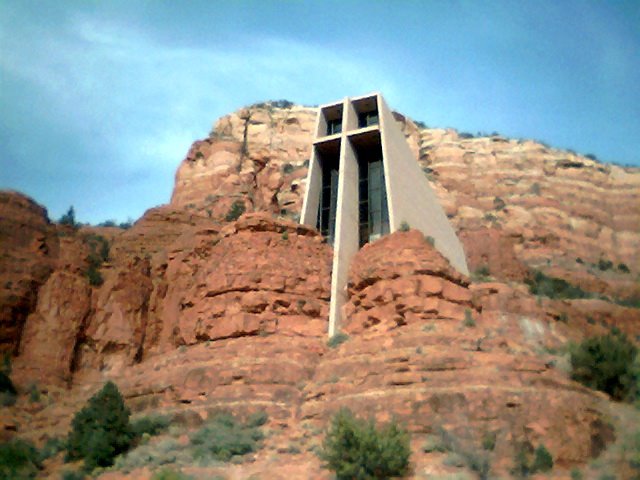
Chapel of the Holy Cross - Sedona, AZ


John 20:1-18 "The New American Bible", Thomas Nelson Publishers, New York, 1983, pages 1172-1173

Saturday, April 15, 2006

Sean & McGillicuddy Trick the Easter Bunny
by Chuck & Victor

One bright sunny day in Leprechaun Land, Sean, McGillicuddy and Armagh were sitting on the playground talking. "Guess what?" said Armagh "Tomorrow is Easter." "What's Easter?" asked both Sean and McGillicuddy. Since the boys didn't know anything about Easter, Armagh decided that she might pull a little joke on them. "Well," she explained, "Easter is when the Easter Bunny comes hopping around Leprechaun Land with his basket of Easter eggs. If you want to get some Easter eggs, you have to set up a trap to catch the Easter Bunny."

Sean and McGillicuddy thought for a moment. "We should start now if we want to get Easter eggs." McGillicuddy declared. He and Sean said goodbye to Armagh and left.

"Those goof balls crack me up," Armagh said laughing to herself, " everyone knows there's no such thing as the Easter Bunny."

Later that night, Sean and McGillicuddy had finished their trap. They tied a rope to a tree and tied the other end to a net on the ground that was covered by leaves. They placed a carrot in the center of the trap. Soon after they fell asleep, they woke up to hear a hopping sound outside. They both snuck out of their houses and darted behind a tree so the Easter Bunny wouldn't see them.

The Easter Bunny saw the carrot, and looked down at his growling stomach. "All this Easter business is making me hungry," he said to himself," I think I can take a break to enjoy a little snack." He hopped over to grab the carrot. Suddenly, the net gave way under his feet and he soon found himself trapped, dangling above the ground.

Sean and McGillicuddy jumped out from their hiding place and started celebrating. "We caught him! We caught him!" they sang out loud.

It just so happened that the Leprechaun King was out for his nightly stroll. He saw Sean and McGillicuddy dancing around something caught in a net above the ground. He decided to get to the bottom of this. "Sean, McGillicuddy! What are you two doing outside past your bedtimes? And what is trapped in that net?" He peered inside. "Why is the Easter Bunny caught in this net? You lads have some serious explaining to do!" Sean and McGillicuddy explained that Armagh had told them to trap the Easter Bunny in order to get eggs for Easter. "Well, this is very serious," the Leprechaun King said," I'll explain this to the Fairy Queen so she can take care of Armagh. As for you two," he pointed to Sean and McGillicuddy," You will assist the Easter Bunny and help him hide eggs tonight, and you will do it as rabbits yourselves." With his great leprechaun magic, the King turned Sean and McGillicuddy into little bunnies.

Then they went out into the night to help the Easter Bunny deliver eggs. When they were done, the spell wore off and they became leprechauns again. They went back to their houses and went to bed just as the sun was starting to rise. Several minutes later, Sean and McGillicudy's parents walked into their rooms to wake them up for church. The parents were unaware of the events that happened the night before. They couldn't figure out why Sean and McGillicuddy were so tired. The parents decided that both boys weren't getting enough sleep, so they made their bedtimes earlier.

When the Fairy Queen was informed about Armagh, she decided that Armagh's punishment would be to help the Easter Bunny make chocolate eggs and other treats for the following Easter. Armagh was dumbfounded at the fact that the Easter Bunny was real.

As for Sean and McGillicuddy, they had learned their lesson and were going to be good little leprechauns from that time on and not listen to deceptive little fairies like Armagh.

Copyright (c) 2006 by Charles Nugent
All rights reserved. No part of this material may be reproduced, in any media, without the express written consent of the copyright holder.

Sunday, April 09, 2006

Palm Sunday
by Chuck


Palm Sunday is the sixth Sunday in Lent and the Sunday before Easter. It is celebrated in all major Christian churches - Roman Catholic, Protestant and Orthodox. In popular parlance it is called Palm Sunday because it commemorates the triumphant entry of Jesus into Jerusalem to celebrate the Passover. The Gospels describe how the crowds lined the route, spread palm branches on the road and waved palm leaves in their hands enthusiastically as Jesus rode in on his donkey. Hence, the name Palm Sunday.

However, until 1970 the official name of this day in the Roman Catholic Church was the Second Sunday of the Passion. In 1970 the the Roman Catholic Church changed the official name to Passion Sunday which has caused confusion for those who were used to referring to the fifth Sunday in Lent as Passion Sunday (that Sunday is now officially called the fifth Sunday of Lent). But, for the average Christian, Catholic and non-Catholic alike, this day is still known as Palm Sunday.

In addition to palm trees being common in the Mediterranean world and its leaves a logical material to cover a dusty road, palm leaves were also a symbol of victory and triumph in the ancient world. The cheering crowds along the road gave evidence to the effectiveness of Jesus' message and the large following he had attracted. It is no wonder that the religious and political establishment were concerned about his popularity and the potential threat to their earthly power that it represented. However, Jesus' kingdom was not of this earth and he was not seeking earthly power. While his followers hailed his entry into Jerusalem with palm leaves which symbolized triumph and victory, Jesus himself elected to be borne on the back of a humble donkey rather than a horse. The horse is a powerful animal that was used in war. The horse represented conquest and power. Throughout history horses were the preferred means of travel for the rich and powerful. The donkey, however, is puny compared to the horse and is a simple beast of burden used by the common masses. As Christ repeatedly stated, his kingdom was not of this world but rather that of heaven. He urged his followers to focus on and prepare for eternal life in heaven, not political change on earth.

The memory of Christ's triumphant entry into Jerusalem just before his crucifixion was kept alive and celebrated from the earliest days by the Church in Jerusalem. The celebration included re-enactments of the Lord's triumphant entry into Jerusalem and the the waving of palms. The custom gradually spread to other churches in the eastern Mediterranean, reaching Constantinople (modern day Istanbul, Turkey), capital of the Roman Empire in the east, by the fifth century. In time the celebration spread throughout the Church and was retained by many Protestant churches following the Reformation. In areas where palms were not available, people used branches from local trees that bloomed in the spring. Today, modern transportation enables churches throughout the world to easily obtain and distribute palms on this day.

In many Orthodox Churches Palm Sunday is referred to as Entry into Jerusalem. Due to the fact that for religious purposes many of these churches use the Julian rather than the Gregorian calendar, this date, like that of other religious holidays is usually a week or more later than their counterparts in the Western Christianity. However, just like western churches, Entry into Jerusalem or Palm Sunday is celebrated with the distribution of palms or branches from local trees and marks the beginning of Holy Week. These churches also celebrate the day before Palm Sunday as Lazarus Saturday where they commemorate the raising of Lazarus from the dead by Jesus. On Lazarus Saturday many of the faithful spend time weaving the palms into crosses for distribution the next day. This custom weaving of palms into crosses can also be found in many Protestant Churches and, if one looks around a Catholic Church they will see that many of their fellow participants in the mass have woven the palm branch they received upon entering the church into a cross.

In Roman Catholic Churches in America palm leaves are distributed to the congregation as they enter the church. There are two Gospel readings on this, Passion (Palm) Sunday with the first being read at the start of the Mass. The congregation then holds up their palm leaves and the priest blesses them. Following the Epistle, the Passion Story from the Gospel according to St. Matthew is read. This is a long reading (Matthew 26:14 – 27:66) with sections divided among three or four readers and parts for the congregation. We again hear the story of Jesus' betrayal, capture, trial, torture, crucifixion, death and burial. The congregation takes the palm leaves home where they are kept as a reminder of the Gospel message of the passion. The palms are collected by the Church just before the beginning of Lent and burned to produce the ashes used on Ash Wednesday.

Thursday, March 16, 2006

THE GOLDEN SHAMROCK
by Chuck


Copyright © 1998, 2006 by Charles J. & Victor L. Nugent


One bright sunny morning, Mrs. FitzWarren, the Leprechaun's teacher announced that the class would take a field trip today to the King's Library. Now the King's Library is a big building that was built too long ago for anyone to remember. It contains thousands of books that the Leprechaun Kings had collected over the eons.

When their school bus pulled into the parking lot of the Library the little leprechauns were awed by the huge gray castle like building with a tower that seemed to reach to the clouds. Barely visible at the top was a door leading to the parapet from which a person could see half of Leprechaun Land. As the leprechauns gazed up at the tower, McGuilicudy was thinking not about the great view from the parapet but, rather, how far his ball would bounce if he dropped it from the parapet.

Inside the library they were given a tour by old Miss Lacy, the chief librarian, who looked and talked like she had been there from when it was first built. Miss Lacy knew everything about the library. She even described the Tower which contained hundreds of books that no one, except Miss Lacy, had looked at for over three hundred years.

When the tour was finished Mrs. FitzWarren told the class that they were to explore the bookshelves and make a report about what they found. McGuilicudy, ever the clever little leprechaun, asked if they could explore any part of the library they wanted and the unsuspecting Mrs. FitzWarren said "yes". McGuilicudy then announced that he and Sean would explore the Tower.

Now McGuilicudy had no desire to spend the day looking at books. His plan was to get to the top of the tower and drop his ball from the parapet. He hoped that his friend, Sean, would check out the books while he was dropping his ball. But if Sean didn't look at the books that was OK, because, since no one had visited the Tower in eons, he and Sean could just make something up and no one would know the difference.

So, before Mrs. FitzWarren could say "no", McGuilicudy, with Sean in tow, struck out for the Tower.

The Tower was dark and foreboding and Sean was scared, but McGuilicudy, thinking of nothing but how far his ball would bounce, dragged him down the winding corridors and up the stairs. Shelves of ancient books rose to the ceiling in seemingly endless rows. Ancient tomes, half buried in dust from ages past, stared down silently as the two leprechauns scurried past.

As they climbed the seemingly endless stone steps on the way to the top, they began to tire and were finally forced by fatigue to pause for a rest. Wearily leaning up against a shelf loaded with books, Sean accidentally leaned against a huge book, causing it to fall with a crash. He and McGuilicudy jumped back in terror as the crash of the book on the stone floor broke the scary silence of the Tower. Sean and McGuilicudy, fearing Miss Lacy would be attracted by the noise and would punish them for disturbing one of her precious books were about to run back when they noticed the words "Golden Shamrocks" across the top of the page which the book had opened to when it fell. Curious, they proceeded to read the page.

The book was about magical plants of Leprechaun Land. and described a rare shamrock, so rare that usually no more than one grew in a field per year. The leaves of this shamrock had little specks of gold in them. But what was more amazing was the fact that when the first rays of the sun touched the leaves of this shamrock in the morning the three leaves of the shamrock turned to pure gold for an instant. If someone touches the leaves at the same instant they get three wishes.

Sean and McGuilicudy read this with fascination. Just before they finished the page, the voice of Miss Lacy echoed through the corridor warning them that their class was about to leave and that they were to return immediately. Not wanting to be left behind, they got up and ran back downstairs leaving the book where it lay. They left without taking time to read the last paragraph on the page which warned that the magic of the golden shamrock was dangerous and that people accepted the wishes of the shamrock at their peril!

Back in class, Sean and McGuilicudy told about their discovery of the golden shamrock article. Now, they would have been better off following McGuilicudy's original plan and making something up, because Mrs. FitzWarren, finding the idea of magical, golden shamrocks preposterous accused them of making that up! What was worse was that she gave them a zero for the project and that would mean an "F" on their report cards.

Now they were in a fix! Even if they could go back to the King's Library and find which corridor the book was on, which would have been very difficult, they feared the wrath of Miss Lacy for, first knocking one of her precious books on the floor and then for leaving it there. But they also did not relish the thought of having to face their parents in a couple of weeks with report cards
containing an "F".

What could they do? "I know" said Sean. "Lets find one of the magical golden shamrocks. That will prove that we were telling the truth". Not having any other idea of his own, McGuilicudy agreed try Sean's idea.

So, for the next week, Sean and McGuilicudy spent all of their free time on hands and knees exploring the meadows looking for a shamrock with specks of gold in its leaves. As their friends played, they worked at finding the magical shamrock. Finally, just before they were ready to give up, Sean spotted a shamrock with specks of gold in its leaves. Placing a marker by it so they could find it again, they went home and went to bed early.


Rising before sunrise, Sean and McGuilicudy raced out to the field and awaited the first rays of the sun. They shivered in the chill of the early morning and the dark, pre-dawn silence was broken only by the hungry growling of their empty stomachs.

Soon the sky began to brighten and Sean and McGuilicudy readied themselves to touch the magical leaves. Suddenly the sun pulled itself up over the horizon and its golden rays spilled over the cold meadow. Sean and McGuilicudy touched the leaves in the same instant as did the sun's rays.


The leaves of the shamrock changed to pure gold and a voice emanating from the meadow informed them that they each had three wishes which they had to make immediately. Without thinking, each wished for a warm jacket and a hot breakfast (they had left home without jackets or breakfast). Magically their jackets and a delicious hot breakfast appeared for each. Warm and fed, they thought a moment about what they should use their last wishes for. They needed something that would convince Mrs. FitzWarren and their classmates that the magical golden shamrock was real.

They thought and thought. Finally, McGuilicudy said, "I know. We will wish to be invisible. That way we can play tricks on the class all day and, when we re-appear, they will have to believe us".

So they wished to be invisible - but forgot to stipulate for how long.

It was fun at first. They went to school and sat in their seats. When Mrs. FitzWarren called their names they each answered "here", but, when she saw the empty seats she scolded Shamus and O'Rourke, who sit next to Sean and McGuilicudy, for talking out of turn.

When Mrs. FitzWarren told the class to hand in their homework, Sean and McGuilicudy put theirs on the top of the pile. During math, Mrs. FitzWarren wrote some problems on the board and, when she turned to select students to come up and write the answers, Sean and McGuilicudy wrote the answers on the board. She gave a spelling test and Sean and McGuilicudy each took it and placed theirs on the top of the pile. What was really perplexing to Mrs. FitzWarren was that, not only were Sean and McGuilicudy's homework and tests being handed in, but McGuilicudy got his usual five out of ten words wrong in spelling.

Just before recess, McGuilicudy went around the room tying everyone's shoe laces together. When Mrs. FitzWarren told them to go to recess they all got up and promptly fell down. At recess, the invisible McGuilicudy joined in the soccer game and, led his team to victory with all kinds of cheating that went undetected because he was invisible. When Mrs. FitzWarren went outside to call the class in from recess, McGuilicudy ran into the room and locked the door. The class got an extra fifteen minutes of recess while they waited for old Mr. O'Dowd, the janitor, to come with the keys to open the door. McGuilicudy's last and best trick was to go through everyone's lunch box and, in addition to eating all the cookies he found, switching everyone's lunch.

When the rest of the class went to lunch McGuilicudy, having gotten a stomachache from eating so many cookies, went to the back of the room and sat down next to Sean.

"We have a problem" announced Sean. "I know" said McGuilicudy. "How can I get the nurse to call my mother to take me home because of this awful stomachache when neither can see me?" "No, we have a worse problem", said Sean. "We don't know how to become visible again".

This was serious, so serious that McGuilicudy forgot about his stomachache. So they went and found Mrs. FitzWarren and, after a lot of effort convinced her that they were really invisible. This explained all the strange happenings of the morning.

After informing them that they each had six weeks of detention for all of their mischief (most of it was McGuilicudy's doing but, not being able to see them, both got blamed), Mrs. FitzWarren arranged for them to be taken back to the Library.

At the Library Miss Lacy told them to follow her as she searched for the book they knocked over. Turning a corner she saw it laying open on the floor and let out a scream of horror at the sight of one of her precious 500 year old books laying open on the floor.

Unlike Sean and McGuilicudy, Miss Lacy read the entire article about the magical golden shamrocks, learning both the dangers of the magic and the potion needed to undo the magic. Actually, the potion was quite simple. Simply pick 100 shamrocks each, boil them for twenty minutes and eat them. Unfortunately, the boiled shamrocks of Leprechaun Land. taste just like spinach - the food that both Sean and McGuilicudy hated the worst!

After swallowing the last spoonful they re-appeared to face the angry Mrs. FitzWarren with their detention slips and the even angrier Miss Lacy with a dust rag for each. For knocking over one of her precious books, she insisted that they spend their weekends for the next year dusting all the books in the Tower - this would be the first time in 350 years that they would be dusted.

Despite the detention and dusting, our story does have a happy ending. You see, Sean and McGuilicudy's actions, drastic though they were, did convince Mrs. FitzWarren that they had read about magic golden shamrocks. So she changed their zeros to 100s and they each got an "A" instead of an "F" on their report cards in reading. Of course McGuilicudy got his usual "F" in spelling but his parents were used to that.

Thursday, February 23, 2006

The Tucson Rodeo Parade
by Chuck


Today is the day for Tucson's annual Rodeo Parade which heralds the beginning of Rodeo Week in Tucson. The parade, which has been held annually since 1925, is the start of Tucson's week long rodeo which draws entrants from across the U.S. and Canadian west. As the first major outdoor rodeo on the Pro Rodeo circuit, the Tucson Rodeo is the start of the outdoor rodeo season. As such, the parade and rodeo are big events in Tucson and are celebrated accordingly.


Local schools close on Thursday (the day of the parade) and Friday of Rodeo Week each year. Each year the police and a local "vigilante" group identify one vehicle on Interstate -10 with out of state license plates and signal it to pull over. The anxious occupants are then surprised with a gift pack consisting of six days worth of free meals and lodging at a local resort along with free passes to local attractions.


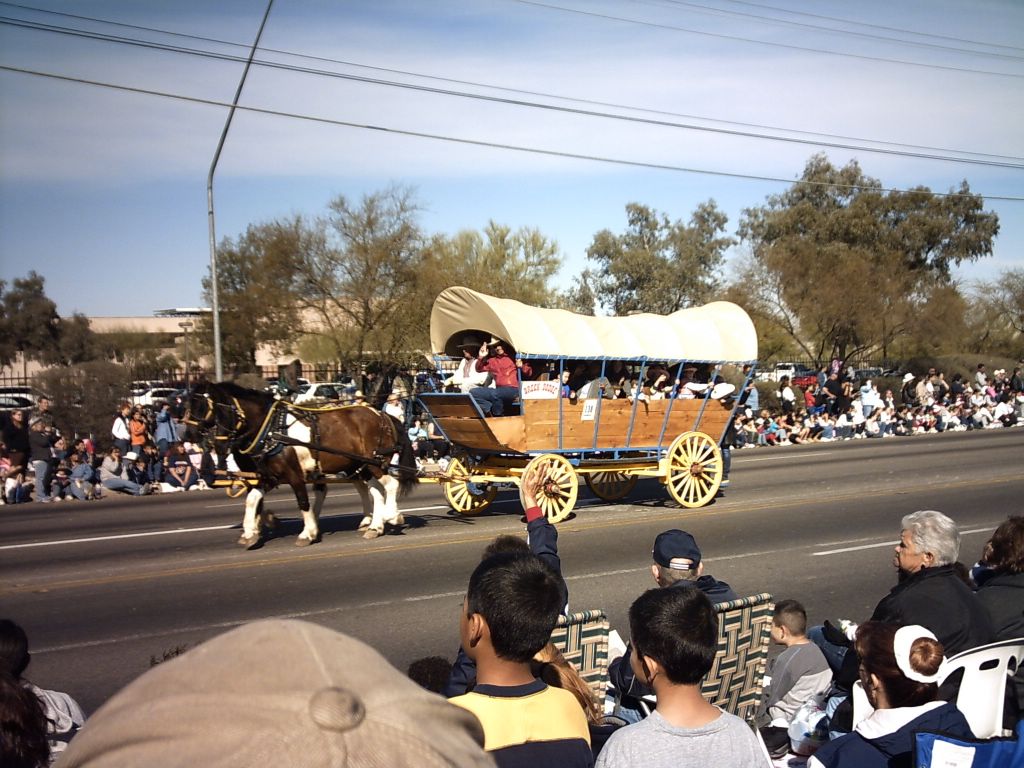
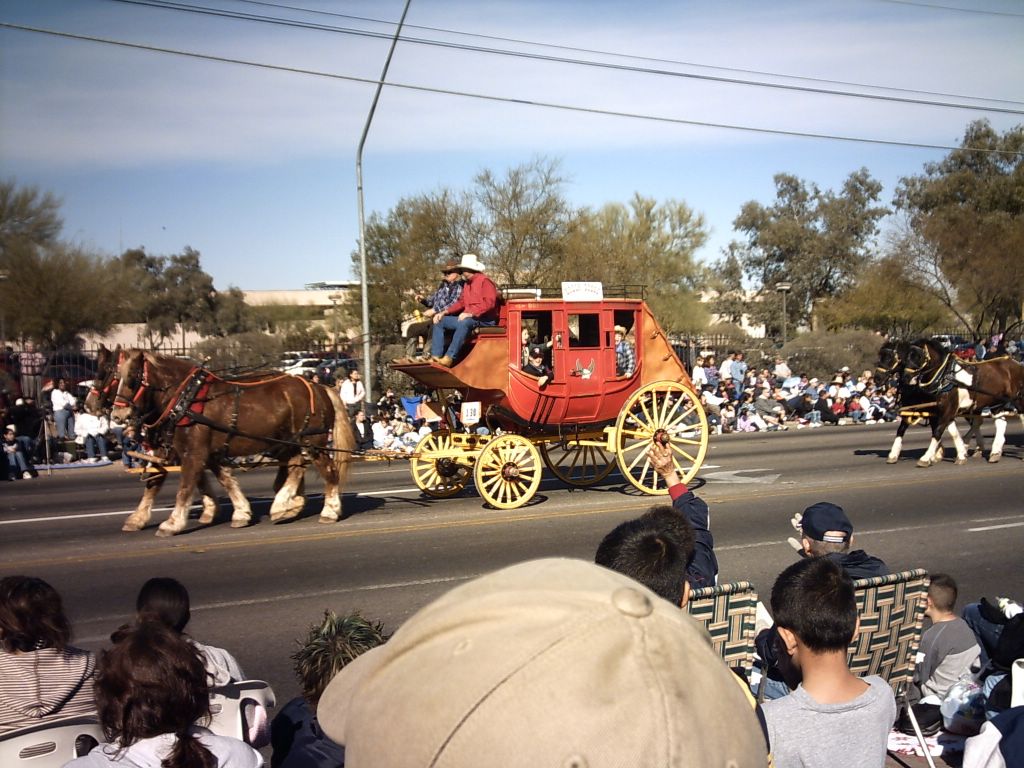
The parade itself attracts about 200,000 spectators who line the route to view the two hour long parade with its numerous old horse drawn wagons, costumed riders and marching bands. Being Tucson, the weather usually cooperates with sunshine and balmy temperatures. As the parade starts at 9 a.m. the temperature is usually between 40 and 50 degrees and then proceeds to rise to the 60 to 70 degree range by parade's end.


The two hour long event consists of local bands, mounted horsemen and women, antique wagons and western theme floats. Parade rules and tradition forbid mechanized vehicles so all wagons and floats are horse drawn. People in the floats and wagons usually dress in either traditional western wear or traditional Mexican dress.

Many floats and marchers dress in historical costumes commemorating Tucson's rich historical past. Among the costumes are riders on beautiful Arabian horses dressed as Spanish Conquistadors with spears and shields embossed with Spanish style coats-of-arms. These were the mounted soldiers who accompanied Padre Kino and other Spanish missionaries as they pushed the borders of New Spain north from Mexico into what is now the southwestern U.S. and, in the process founded the settlement that is now Tucson. Others dress in traditional Mexican cowboy garb with their broad sombreros reminiscent of the cowboys who maintained the ranches during the period before the U.S. government purchased southern Arizona from Mexico and Tucson was a small Mexican town. Nineteenth century U.S. Army Calvary costumes are another reminder of our past and, thanks to old Hollywood movies, a staple of the Old West in people's minds. Included with the Calvary are units representing the black "Buffalo Soldiers" who played a significant, but often neglected, role in the settlement of the southwest. These former slaves, who found work as soldiers and moved west with the Army, made up an important part of the Army's troop strength in Arizona following the Civil War. And then there are representatives from the local Tohono O'odahm Nation and Pascua Yaqui Tribe Indians. But instead of Hollywood style indian garb they usually dress in the more traditional working cowboy garb common to this area's past and present.


Buffalo Soldiers

The parade ends at the rodeo grounds and this afternoon the first of the week-long series of rodeo events will begin.

Wednesday, February 22, 2006

George Washington's Farewell to his Troops
by Chuck

February 22nd is the birthday of George Washington, the Father of our country. Father is an appropriate adjective to describe Washington because, not only was he a good father to his two step-children, but, like a good father, he led by example and many of the best traditions in our government were started by Washington. After serving two terms as President, he observed that eight years was long enough for one many to serve as president and elected to step down. This tradition of no more than two terms as president was respected by his successors and the voters for almost a century and a half until Franklin Roosevelt, using the excuse that continuity was needed to succeed in winning World War II, got himself elected to four terms of office (he died before completing his fourth term and it was his Vice President and successor, Harry Truman who presided over our victory in that war). Enough voters and members of Congress were sufficiently concerned by Roosevelt's action that, following the end of the war they amended the Constitution to limit all future presidents to no more than ten years in office (if the president leaves office with two years of less of his term remaining the Vice President can serve those years and then run for two more terms, but if there are more than two years left in the departing President's term, the Vice President can only serve out that term and run for only one more term).

One of the many great legacies Washington left us was the tradition of the military being subservient to the civilian arm of the government. This did not originate with Washington as the Continental Congress, in theory at least, had the power to appoint and fire military officers. But having authority and being able to use that authority are two different things. Successful and popular military commanders before and after George Washington, have routinely displaced their weak, and often incompetent, civilian bosses. In ancient Rome the Senate ruled supreme and military commanders, even if they were heros, were not allowed to enter the city of Rome with their army. But this did not stop Julius Caesar from crossing the Rubicon with his army and replacing Senate rule with his rule. Simon Bolivar, often called the George Washington of South America refused to bow to civilian authority and, after successfully freeing South American from Spanish rule proceeded to retain power as a dictator.

Washington was different. Like most successful people he was proud, ambitious and hard working. However, his pride was tempered with humility. This was not a self depreciating humility, but rather an acknowledgment that he was not a god but a human, created by God like other humans, with talents that he was expected to not only use but also be held accountable for how he used his talents. Acknowledging that he was human and had limitations, allowed Washington to keep things in perspective and not allow his power and success to go to his head. To use a term popular today, Washington was well grounded in that he knew what was important – his family, his farm, his faith, his reputation – and the rest was duty to be honorably discharged so that he could then return to his wife and his farm which were the things that were most important to him.

George Washington was a skilled military commander who had proved his worth in the French and Indian wars earlier in his life. When the Revolution came he actively lobbied for the job as commander in chief of the Continental forces. However, there were other men who were also qualified and who longed for the same position. Even after Washington was given the commission as commander of the Continental forces these men continued to lobby for the job, forcing Washington to fight a two front war – one by day against the British army in the field and one by night defending his actions and wooing Congressional support with letters. Washington truly believed that he was the best man for the job and worked hard to both get and retain the job as commander of the Continental Army.

Unlike many revolutionaries, Washington built, practically from nothing, a professional army that engaged the British army throughout the war. While gurella forces were involved in the war, Washington did not allow the the American cause to disintegrate into a prolonged guerilla action that took decades to wear the enemy down. When the war ended and the last British troops left New York City in the late fall of 1783, George Washington was the commander of the largest army in North America. He was not only the commander but the highly respected leader of his officers and men who, flush with the pride of victory over the most powerful nation in the world, were willing to follow him anywhere. He was also one of the very few men who was known throughout the thirteen colonies. At this time the thirteen colonies were simply a loose confederation of semi-soverign nations each preoccupied with its own affairs and local leaders. Most of our founding fathers were really local leaders and virtually unknown outside their respective states. Washington was a truly national leader who was both well known and well loved and respected by all. Finally, the country was drifting. Inflation was rampant. Congress was weak and its members preoccupied with local special interests. The soldiers and officers were upset by not having been paid and longing to get back to their families and farms.

George Washington was at a crossroads. He could march his army to Annapolis, Maryland where the Continental Congress was currently meeting, take control of the country and straighten out the apparent mess. Or, he could stick by his principles and his vision of a nation of free people caring for themselves, and leave the army to return to his wife and farm. He choose to surrender his command and go home. Angry over lack of promised pay and feeling that Congress did not appriciate their sacrifices, the army was ready to follow Washington if he chose to overthrow the weak civilian regime and replace it with a military dictatorship with him at the head.

Instead, Washington sent out an order for his senior officers to meet with him at the Long Room of Fraunces Tavern at noon on December 4th so that he could bid them farewell. In notes made by some of those in attendance following the meeting report that it was an emotional farewell in which Washington urged them to instruct the junior officers and enlisted men to behave honorably, disband and go home to be leaders in their communities. He had the senior officers agree to join him in working to see that the men received all of the back pay that they deserved. He then bid them farewell and left for Annapolis where he personally presented his resignation to the Congress. Thus, Washington, by his example, established the principle that the military takes orders from and is accountable to the elected civilian rulers.

Below is Washington's resignation address given to Congress on December 23, 1783:

[To the Continental Congress]

[Annapolis, Md. 23 December 1783]

Mr President

The great events on which my resignation depended having at length taken place; I have now the honor of offering my sincere Congratulations to Congress & of presenting myself before them to surrender into their hands the trust committed to me, and to claim the indulgence of retiring from the Service of my Country.

Happy in the confirmation of our Independence and Sovereignty, and pleased with the oppertunity afforded the United States of becoming a respectable Nation, I resign with satisfaction the Appointment I accepted with diffidence-A diffidence in my abilities to accomplish so arduous a task, which however was superseded by a confidence in the rectitude of our Cause, the support of the Supreme Power of the Union, and the patronage of Heaven.

The Successful termination of the War has verified the more sanguine expectations-and my gratitude for the interposition of Providence, and the assistance I have received from my Countrymen encreases with every review of the momentous Contest.

While I repeat my obligations to the Army in general, I should do injustice to my own feelings not to acknowledge in this place the peculiar Services and distinguished merits of the Gentlemen who have been attached to my person during the War. It was impossible the choice of confidential Officers to compose my family should have been more fortunate. Permit me Sir, to recommend in particular those, who have continued in Service to the present moment, as worthy of the favorable notice & patronage of Congress.

I consider it an indispensable duty to close this last solemn act of my Official life, by commanding the Interests of our dearest Country to the protection of Almighty God, and those Who have the superintendence of them, to his holy keeping.

Having now finished the work assigned me, I retire from the great theatre of Action-and bidding an Affectionate farewell to this August body under whose orders I have so long acted, I here offer my Commission, and take my leave of all the employments of public life.


Source: http://gwpapers.virginia.edu/documents/revolution/resignation.html

Monday, February 20, 2006

Preserving the Memory of our Veterans
by Chuck

Reading the spring issue of USAA Magazine (published by the USAA the Insurance and Financial Services organization for current and former members of the military) the other morning while eating breakfast I ran across a short piece about the Registry of Remembrances for World War II veterans at the World War II Memorial being built in Washington, D.C. Veterans, living or deceased are not automatically registered by the government. Instead the veterans or their families have to enter them into this electronic registry.

Names can be added by going on line to wwiimemorial.com. I have taken a quick look at the site and the registry is just one part of it. At the site you can check to see if the veteran in question has been entered as well as making the entry yourself. A quick check revealed that my father has not yet been entered but I intend to correct that shortly. From my brief look it appears to be a simple name and home state registry but, when I go in to register it may turn out to be more extensive. I did notice a place for photos so the information that can be entered probably will be more extensive. Names can also be added by calling 1-800-639-4992.

A second site, related but apparently not connected to the WWII memorial is the Veteran’s History Project which is dedicated to preserving veteran’s stories from World War I, World War II, the Korean War, the Vietnam War, the Gulf War and the current Iraq and Afghanistan conflicts.

As with the registry, the entries can be made by the veteran himself or herself or by relatives. The stories can be a remembrance written for the project, an oral recording of remembrances, letters, diaries, photos, etc.

The Veteran’s History Project is supported by the U.S. Congress and the Disabled American Veterans Charitable Service Trust and is a part of a larger American Folklore program operated by the Library of Congress. The website is loc.gov/vets. You can also call 1-888-371-5848.

Again, I only had time to spend a couple of minutes on this site but the project not only seemed extensive but also contained a downloadable kit with forms and instructions for collecting and submitting the information, as well as questions designed to assist a veteran in telling their story.

Like the registry, this site appears to be a great way to both honor and remember the legacy of these veterans. The Veteran’s History Project is also a great way to preserve and publish photos, diaries, letters, etc. for future generations. These types of things are often discarded when closing the homes of the veteran’s when they die or simply get lost or disintegrate with age. If you have these types of materials and are either not interested in saving them yourself and/or wish to share them with the future now would be a good time to donate them to this project. However, if you do have plans for future publication of this material (and there is a growing market for published veteran’s first hand accounts) be careful before donating them as you may be giving up copyrights and future publishing rights.

Wednesday, February 15, 2006

The Search for Maggie Ward
A Book Review by Chuck

The Search for Maggie Ward
by Andrew M. Greeley
Thorndike Press, 1991, 726 pp.
ISBN: 1-56054-980-7


Discharged from the Navy in 1946 following the end of World War II, Jerry Keenan is taking a slow trip home to Chicago. A former naval aviator with two Navy Crosses and no physical scars from the war, Jerry is struggling with inner pain and nightmares from his war time experiences.

While having breakfast in the cafe at the railroad station in Tucson, Arizona, Jerry notices a young woman sitting nearby. Something about the frail and almost ghost like woman stirs Jerry's thoughts away from his own troubles and toward her. Having all but lost his faith in God and having lived with death and horror for the past couple of years, Jerry was close to dead inside. But the sight of this young woman stirs Jerry and begins to rekindle both romantic and sexual desires which have been suppressed by the horrors of the past couple of years of war. The re-emergence of the suppressed romantic and sexual feelings restore his urge to live and he sets off to find this woman.

But the young woman turns out to be struggling with her own demons which Jerry must uncover and overcome in his quest to both discover the real woman behind the emotional wall she has erected around herself and to breech the wall and win her love. In doing so Jerry reacquires his faith in God and will to live and love.

Monday, February 13, 2006

SEAN & MCGILICUDY and The Shot

Copyright (C) 1993, 2006 by Charles J. Nugent, Victor L. Nugent & David A. Delgadillo


One day, as Sean the Leprechaun was playing with his friend McGilicudy, Sean's Mom can in and said, "Sean, it is time to get ready to go and get your shot". "Shot", McGilicudy said. "That is fun! I went with my Dad last night. We shot a gun and won prizes." "Oh, boy!", said Sean. "Can I come with you?" asked McGilicudy. "Let me ask my Mom" said Sean. Sean's Mom said than McGilicudy could come and soon they were off - TO THE DOCTOR'S OFFICE!

Sean and McGilicudy were so excited! When they reached the doctor's office McGilicudy thought that something didn't look right but he didn't know what it was. It just did not look like the place he and his father had shot guns the night before. They waited in the waiting room. Both Sean and McGilicudy listened for the sound of shots but heard none. Then they were called into the examining room. Sean and McGilicudy eagerly followed the nurse. But McGilicudy still kept feeling that something was wrong. He just did not know what it was. As soon as they entered the examining room McGilicudy knew instantly what was wrong. This was where the Doctor gave you a shot with a needle - not where you got to shoot a gun! But before McGilicudy could warn Sean and tell him of the terrible mistake the door closed. There stood the Doctor. McGilicudy stood frozen with fear as he remembered standing here for his pre-school physical a year ago. He could feel the shot again.

Sean was still wondering where the guns were as the doctor examined him - but he thought that she was just measuring him to see what kind of gun he could hold. Seemingly without warning, the Doctor pulled out her needle and prepared to give Sean his shot. McGilicudy felt bad about giving Sean the wrong idea about the shot - but he had just made a mistake. Poor Sean, before he knew what was happening Dr. Seamus stuck the needle in his arm and gave him his shot. He started to cry - more from fear and surprise than pain.

As Dr. Seamus removed the needle, McGilicudy backed up against the wall and pleaded, "Please don't give me a shot - I had one last year before I started school." Dr. Seamus quickly assured him that she would not give him a shot.

But poor Sean was still crying and said, "I thought we were going to shoot a gun and get a prize". At that moment both Dr. Seamus and Sean's Mother realized what the confusion was all about.They explained to Sean and McGilicudy that you get SHOTS from a needle to keep you strong and healthy or take SHOTS at a target with a gun to win prizes. Sean and McGilicudy now realized their mistake - one word two meanings, the world could be really confusing at times.

But Sean was still crying. "I really wanted one of those prizes", he said. "No problem" said Dr. Seamus as she rang for the nurse who soon came running with a box of prizes. "Since I never miss with my shots, you always win a prize here" she said with a smile. A bright smile came across his face as Sean reached in and selected his prize - a nice red squirt gun. Seeing a green squirt gun next to it Sean said "Can McGilicudy get a shot too so that he can get the green squirt gun?"

Poor McGilicudy stood frozen - afraid to get a shot and afraid of not getting the green squirt gun so that he could play with Sean. But sweet old Mrs. McGreggor, the nurse, seeing poor McGilicudy's plight quickly came to his rescue by suggesting that he be given a prize for having received a shot the year before.

Everyone left happy.

Wednesday, February 08, 2006

Thought for Today

People are always blaming their circumstances for what they are. I don’t believe in circumstances. The people who get on in this world are the people who get up and look for the circumstances they want, and if they can’t find them, make them.
George Bernard Shaw (1856-1950)

Monday, February 06, 2006

Robert Herrick (1591-1674) - Three Candlemas Poems

Robert Herrick (1591 – 1674) was an English poet in the time of Charles I. He graduated from St. John's College, Cambridge in 1617 and took religious orders in the Church of England ten years later in 1627.

While he remained single all of his life many of his poems are about women, lovemaking and the female body. He also wrote spiritual and other lyrical poetry.

Our interest in him here centers on three poems below dealing with Candlemas.


CEREMONIES FOR CANDLEMAS EVE

Down with the rosemary and bays,
Down with the misletoe;
Instead of holly, now up-raise
The greener box, for show.

The holly hitherto did sway;
Let box now domineer,
Until the dancing Easter-day,
Or Easter's eve appear.

Then youthful box, which now hath grace
Your houses to renew,
Grown old, surrender must his place
Unto the crisped yew.

When yew is out, then birch comes in,
And many flowers beside,
Both of a fresh and fragrant kin,
To honour Whitsuntide.

Green rushes then, and sweetest bents,
With cooler oaken boughs,
Come in for comely ornaments,
To re-adorn the house.
Thus times do shift; each thing his turn does hold;
New things succeed, as former things grow old.


CEREMONY UPON CANDLEMAS EVE

Down with the rosemary, and so
Down with the bays and misletoe;
Down with the holly, ivy, all
Wherewith ye dress'd the Christmas hall;
That so the superstitious find
No one least branch there left behind;
For look, how many leaves there be
Neglected there, maids, trust to me,
So many goblins you shall see.


THE CEREMONIES FOR CANDLEMAS DAY

Kindle the Christmas brand, and then
Till sunset let it burn;
Which quench'd, then lay it up again,
Till Christmas next return.

Part must be kept, wherewith to teend
The Christmas log next year;
And where 'tis safely kept, the fiend
Can do no mischief there.

Thursday, February 02, 2006

Willie Woodchuck Misses Groundhog Day
by Chuck

Willie Woodchuck swallowed the last morsel of the tender roots he and his wife had been dining on in the meadow by their home. It was a beautiful fall day but he knew that soon the north wind would bring cola and then snow to the land. However, he didn't care because he and his wife had a nice snug borough among the roots of the old oak tree behind them. He and his wife had been gathering fresh grass and leaves to make warm and cozy beads for their long winter's sleep. The summer had been good and the food plentiful. Now both he and his wife had a large layer of fat around their tummies. The fat would keep their bodies warm and nourished as they slept the coming winter away.

Yes, life was good, but Willie was troubled. As the local groundhog, it was Willie's job to wake up from his winter sleep on February 2nd and check the weather by looking for his shadow. If he crawled out of his borough and saw his shadow he would know that winter would continue for six more weeks. If this was the case he would immediately return to his borough and resume his sleep. But, if he didn't see his shadow he would know that winter was ending and would proceed to start looking for food and starting another spring and summer.

Willie enjoyed being the local groundhog and letting the world know each year how soon spring would come. In the past people and animals would come from all over to see him come out and look for his shadow. He loved that moment of glory each year and had eagerly looked forward to waking up and going outside on February 2nd.

But in recent years fewer and fewer people came to see him. Even the animals stopped coming. Why, this past year only old farmer McGilicudy and his horse Molly came. Oh, yes, Roger Robin also came as did Reggie the fox. But he suspected that Reggie was more interested in the chance to have Willie for breakfast than in Willie's prediction for spring. Even Ajax, farmer McGilicudy's faithful hound, elected to remain behind napping in the barn rather than venture out to see Willie.

As he prepared to go to bed for the winter, Willie was still upset. So upset in fact that he decided not to set his alarm clock for February 2nd. I am just going to sleep in and let everyone guess themselves when spring is coming. "Oh! But you can't do that," said his wife. "It is your job and everyone is depending upon you," she continued. "You have responsibilities and must do what you agreed to do when you became the local groundhog." She snuggled into their warm bed of grass and leaves and ended with, "now set the alarm and come to bed, I'm tired."

So Willie set the alarm and went to sleep.

February 2nd arrived and he pulled himself out of bed, turned off the alarm and quietly made his way to the door leaving his wife to continue her sleep.

Emerging from the borough he looked over toward the hill across the stream and saw only old farmer McGilicudy and his horse Molly. Even Roger Robin and Reggie Fox had elected to stay home. Poor Willie, he was so sad. But, remembering that he was the star of this event, he pulled himself together, stood up as straight as he could, sniffed the air and looked down to see if he could see his shadow. His sharp nose had detected the hint of spring in the morning air and so he was not surprised to see that there was no shadow. Spring was a bout to come.

Mustering all the dignity he could, he looked toward the hill, gave a slight bow of his head to his audience of two and proceeded to begin foraging for food. Noticing some new green shoots on the other side of the old oak tree, he dug up some roots and returned to the borough with breakfast for himself and his wife.

Looking down from the hill, farmer McGilicudy felt a twinge of sadness for Willie. He was certain that Willie was saddened by the lack of an audience. "But that is crazy" he told himself. "He's just a woodchuck doing what woodchucks do instinctively. But in his heart of hearts he felt that the little woodchuck was saddened by the poor turnout.

Despite his long winter's rest and the tasty breakfast he had found, Willie was very sad. "I just don't have a place in the modern world" he told his wife. "They have televisions and satellites and don't need groundhogs to predict the weather." No matter how much his wife tried to reassure him, Willie remained despondent all summer.

What Willie did not know was that once home, farmer McGilicudy would tell his wife about Willie not seeing his shadow and she would get on the telephone and start telling her friends and they, in turn, would call other friends. Then farmer McGilicudy would go into town and meet his friends for coffee at Sam's Restaurant.

Among the group having coffee would be TV weatherman Bob. Weatherman Bob would always dismiss Groundhog Day as mere superstition and explain how, with all of his scientific gadgets could really predict the weather. But, in his twenty-five years as the TV weatherman, Bob had never missed coffee with farmer McGilicudy at Sam's Restaurant on groundhog day. That is because he knew that Willie Woodchuck's prediction was always right and, once he had that prediction he would go on TV and make his prediction for spring – without ever mentioning Willie. In twenty-five years Weatherman Bob had always been right about the start of spring. So right, that TV stations all over the country would re-broadcast Weatherman Bob's February 2nd prediction of the start of spring.

The same with the animals. Once back in the barn, old Molly the mare would tell the cows and pigs and other animals. They in turn would tell others they met in the field and so on. This little network was so good that there was not a person nor an animal in the area that did not know about Willie's shadow, or lack of it, within a few hours of his coming out of his borough. But Willie didn't know this and he felt so un-needed.

Farmer McGilicudy also began to feel put upon by the fact that he and Molly were the only ones who bothered to crawl out of their beds on those cold and dark February second mornings to partake in the ritual. Everyone was eager to know what the results were but, like Weatherman Bob, they would pooh-pooh the ritual as a silly old superstition while secretly making their spring plans based upon whether or not Willie saw his shadow.

It was a good and bountiful summer but both farmer McGilicudy and Willie were both still troubled over the events of Groundhog day. As the days began to turn colder and the leaves fell off the trees the thoughts of both were focused on the coming Groundhog day. One fall day, after finishing his chores, farmer McGilicudy took a ride on Molly out to the hill where he stood each Groundhog day to observe Willie. As he stood there, gazing toward the old oak tree, he noticed Willie and his wife eating the last of the roots they had found that day. Finishing their meal, Willie and his wife headed toward their borough to start their winter sleep. Before entering, Willie stood up on his hind legs and looked back toward the hill and saw farmer McGilicudy and Molly. Farmer McGilicudy gave him a sad wave and Willie sadly shook his head and then turned his back and went in to go to bed. Suddenly, both knew there would be no Groundhog Day next spring. Both also had a feeling that spring would be late next year.

Willie set his alarm for late March and settled in for his long sleep.

Farmer McGilicudy arose on the cold February 2nd morning and rode out to the old oak tree but, as he expected, Willie did not show. Returning home, he went back to bed. Soon people were calling him asking about the Groundhog. He told them that it hadn't made an appearance. "Well, when is spring coming?" they asked. Farmer McGilicudy would always answer that by observing that it was only an old superstition and that they should watch Weatherman Bob on TV as his instruments always gave him the correct answer. But weatherman Bob's instruments were not that precise and he didn't have an answer. But TV viewers all over the nation were tuned in to hear his prediction so he had to say something. So he guessed and predicted an early spring. Since he had been right twenty-five years in a row, everyone believed him and began making plans for an early spring. All that is except farmer McGilicudy. He decided to wait and see. Unlike the others, farmer McGilicudy, did not have that much faith in weatherman Bob.

Well, the days did start to get warmer and everyone began to prepare for an early spring. Coats and boots and jackets were put away. Sleds, skates and skies were packed away and bicycles, skateboards and baseball bats pulled from their basement storage. The town put away its snowplows and people put their snow blowers and snow shovels in their garages and brought out their garden tools. Farmers plowed their fields and planted their crops and homeowners dug up the ground and planted their gardens. All were basking in the early spring that was starting to bloom around them.

Then it hit. One day in late February the temperature began dropping. Then the cold wind began blowing. Finally it began to snow. It snowed and snowed and snowed. All night, all the next day and all the next night. Schools closed. Traffic was jammed in the snowbound streets. Fields with their newly sprouting crops were suddenly buried in snow. It was terrible. They were really mad at Weatherman Bob and would turn off their TV sets when he came on for the weather. Nobody believed him anymore. People were angry and confused. The situation was so bad that the mayor called a meeting of the whole town. Everyone blamed Weatherman Bob for his bad forecast and they blamed the Mayor for putting the snowplows away. Wives blamed their husbands for putting away the snow blowers and husbands blamed their wives for putting away the winter coats and boots.

In the fields and forest the animals were also mad. Like their human neighbors, they had also assumed an early spring and had adjusted their lived accordingly. "We had a comfortable alcove in the barn for the winter" said Roger Robin's wife "and we left it to build a beautiful nest which is now totally ruined by the snow and wind." "I left a cozy cave where I was sleeping peacefully and now I'm cold and hungry" said the local bear. As in the town meeting, the animals were angry.

As the chaos and controversy engulfed the meeting, farmer McGilicudy sat quietly, deep in thought. Finally he stood up and a hush spread over the audience. "Friends" began farmer McGilicudy, "we have only ourselves to blame for this." "For years you laughed at the idea that a groundhog could tell the weather." "But, for the last 25 years that little woodchuck in the meadow beyond my field has always been right". "This year none of us bothered with him and I doubt that he bothered to get up to check for his shadow." "Next year, let us all go out to the meadow, as we used to do in the past, and show him that we appreciate his annual prediction."

And that is what they did. The next year the whole town gathered on the hill opposite the old oak tree to watch the appearance of Willie. Animals from far and near also gathered around the tree to await his emergence. After a severe scolding from his wife the summer before, for not doing his duty, Willie had set his alarm clock for February 2nd and decided to do his job whether or not people appreciated it.

As Willie emerged from his borough he heard a great cheer. Looking up he saw the hill covered with people and the oak tree surrounded by all of the animals. He was so proud and so happy. He stood on his hind legs, sniffed the air and glanced down. Seeing no shadow, he proceeded to gather some food to take back to his wife.

That evening viewers all over the nation watched as weatherman Bob, bursting with new found confidence, predicted an early spring and to prove that he was right this year, he instructed the cameraman to roll the film of Willie's emergence from his borough. "Based upon the best scientific data and confirmed by my fury little college, we predict an early spring." And he was proved right when spring did come early.

Wednesday, January 25, 2006

McGilicudy Tricks the Tooth Fairy - Part II
by Chuck & Victor

Copyright © 1995, 2006 by Chuck Nugent, Victor Nugent & David Delgadillo

Continued from Monday...

As darkness settled over the world the tooth fairies flew out in all directions from their castle. They checked each little sleeping boy, girl and leprechaun and, when they noticed a tooth missing, checked under their pillow. If the fairy found a tooth under the pillow they would use their magic to turn it into a dollar bill.

Now there was a new fairy assigned to the area where McGilicudy lived and when she checked McGilicudy she fell for his trick. A more experienced fairy would have double checked - especially when dealing with a mischievous leprechaun, like McGilicudy. But she did not check. She simply performed her magic and turned the soap chip into a dollar.

Now Tooth Fairies have been given their special magic on the condition that it only be used to change teeth into dollars. The monetary authorities have strictly forbidden them to change anything else into money. So, when this fairy changed McGilicudy's soap chip into a dollar, the monetary authorities immediately began to withdraw her Life Space. The poor fairy barely had the strength to make it back to the castle. The other fairies didn't want to see her die and they pleaded with the authorities to spare her as she was obviously the victim of a trick.

The monetary authorities finally agreed to spare her only on the condition that the other fairies find and punish the trickster before sundown. It didn't take them long to find McGilicudy and discover that he had used the old licorice trick on the fairy.

When they caught up with McGilicudy he was at the store ready to pay for Lord Tubac. As he handed over his eight dollars the fairies changed one of them back into a soap chip. The clerk told him that he was a dollar short and returned his seven dollars and soap chip. Poor McGilicudy was so sad - but at least he still had a bigger collection of Space Rangers than any of the other leprechauns.

But the fairies were not done punishing McGilicudy. He packed all of his Space Rangers and his tooth brush and headed over to Sean's. But as he headed over to Sean's, the fairies changed all but one of his Space Rangers into bars of soap. When all the leprechauns went to Sean's room after supper to play,

McGilicudy proudly dumped out his Space Ranger collection. Despite the fact that he didn't have Lord Tubac, McGilicudy still knew that the others would all compete to join his team which was the best. But, instead of wanting to join his team they all laughed at the pile of soap bars that fell out of his bag. Poor McGilicudy, instead of the biggest and best force of Space Rangers, he now had one old ranger - and ten bars of soap. The one saving feature was that Sean, being McGilicudy's best and most loyal friend, let McGilicudy's ranger join his forces and shared his rangers with McGilicudy.

But McGilicudy learned that cheating does not pay and from that day on he never tried to cheat anyone, especially Tooth Fairies, again.

Tuesday, January 24, 2006

Tiny Steps Weight Loss Tips
by Chuck

The new Snapple® ad showing a young woman starting her New Year's resolution to begin a diet and exercise program with the small steps of switching from soda to Snapple® for the start of the diet part and doing a turn in the revolving door to the gym rather than just walking past the gym got me to thinking about other small steps one could take. Getting more exercise and losing a couple of pounds is one of my goals for this year but, like everyone else, getting started is the difficult part.

Here are some ideas which I have started using. I doubt that I will lose any weight with these (I also doubt the Snapple® lady will lose any either) BUT, these tactics should help avoid ADDING more weight.

As Dr. VanGrafland, our family doctor when I was a child, used to advise, diet by reducing the size of the portions you eat rather than eliminating whole classes of food.

Exercise your upper body muscles by pushing yourself away from the table at the end of a meal rather than sitting and continuing to munch.

Take the stairs, rather than the elevator, to go from one floor to another at work.

Instead of sitting in your car in a crowded parking lot waiting for a person in a spot near the store to load their parcels, load their kids, find their keys, tune the radio, etc., pull into one of the many spots located further away from the entrance. You will not only get into the store faster but will also get some exercise.

Walk PAST rather than TO the refrigerator.

While waiting in the check out line at the grocery store, bring yourself up to date on the latest Hollywood scandals and alien abductions by reading the covers of the tabloids rather than checking out the deals on candy bars.

Instead of sitting down to put on your socks or tie your shoes, stand up and balance on one foot to do this.

If you like sweets, as I do, but find it difficult not to eat them when they are available, as I do, don't keep them on hand at home or work. In my case, if it is there I will eat it when I have the urge but I won't take the time to run to the store to buy the item every time I want it.

If you find it difficult to avoid the candy machine at work, make it a point not to keep any money in denominations lower than $10 bills in your wallet – vending machines will usually accept denominations up to $5. Limiting yourself to $10 and higher bills will make it more difficult to give in and buy that candy bar.


Good Luck!

Monday, January 23, 2006

MCGILICUDY Tricks The Tooth Fairy - Part I
by Chuck & Victor

Copyright © 1995, 2006 by Chuck Nugent, Victor Nugent & David Delgadillo


In Leprechaun Land the little leprechauns are much like little children everywhere. Like other little children, the little leprechauns like toys and all of them have their own toy collection. Sean and McGilicudy were no exception and they liked to collect Space Rangers. McGilicudy, of course, had the biggest and best collection. He was proud of his collection and he especially liked the envious looks he got from the other leprechauns when he showed off his collection which he did all the time.

One day after school Sean told all his friends that his parents had agreed that he could invite his friends over to spend the night on Saturday and that each one could bring their Space Ranger collections. They could then spend all night (at least until Sean's parents turned out the lights) having their vast army of Space Rangers defend Sean's bedroom from assorted space creatures.

McGilicudy was very excited and was eager to bring his collection which included all but one of the Space Ranger figures. The only one he was missing, and it was the newest and best Space Ranger, was Lord Tubac Supreme Commander of the Universal Forces of Good. If he could get Lord Tubac in his collection then all of the other leprechauns' Space Rangers would have to obey his Ranger.

He had been saving his money and would be able to buy Lord Tubac soon. In fact he just got a coupon for one dollar off the price of Lord Tubac and, with his allowance, would be just two dollars short of the eight dollars needed to purchase Lord Tubac on Saturday. McGilicudy worked hard all week looking for money on the ground and doing jobs for his parents and neighbors. By Friday he had saved up a total of six dollars and would get his dollar allowance on Saturday. But that would leave him one dollar short. He desperately wanted one more dollar so that he could buy Lord Tubac before going to Sean's on Saturday night. Try as he might he could not find any more jobs to make the money by Saturday.

His only hope lay in a tooth that was just little loose. If he could get that tooth out by Friday night he could put it under his pillow and the Tooth Fairy would change it into a dollar by Saturday morning. There was just one problem the tooth was just a little loose and would take a couple weeks before it would fall out. Poor McGilicudy. He was so disappointed and dejected that he could hardly pay attention in school. Even when his favorite time of the day arrived - story time - he was so sad that he could hardly hear the story. But then in the middle of the story the word "Tooth Fairy" caught his attention. He didn't hear much of the story but he did hear the part about some big animal tricking the tooth fairy by covering up a tooth with a piece of licorice and then making a fake tooth out of soap and hiding it under his pillow.

McGilicudy immediately began scheming. As soon as school was out he ran to his friend Shamus and talked Shamus into loaning him a piece of licorice. McGilicudy then ran home and chipped a piece off the bar of soap in the bathroom. He then went outside and rubbed the soap chip on the sidewalk until he had it in the shape of a tooth. After brushing his teeth for the night, McGilicudy carefully covered his loose tooth with the licorice. He did such a good job that when he looked in the mirror the tooth appeared to be gone. After carefully placing the soap chip under his pillow, he quickly drifted off to sleep.

To be Continued...

Friday, January 20, 2006

Armagha's Last Trick - Part II

Continued from Wednesday January 18, 2006

Copyright (C) 1995 by Chuck Nugent, Victor Nugent & David Delgadillo

The next morning Sean got up and got dressed for school. He had trouble with his shoes but he finally got them on - and then fell flat on his face when he started to walk. Then he noticed that the laces were tied together. He fixed the shoes and then went down to breakfast. As usual, he put a big spoonful of sugar on his cereal while his little sister said grace. As soon as his sister finished he shoved a big spoon of cereal into his mouth - and immediately spit the salty mess out! His father, being a college graduate, immediately realized what had happened and proceeded to pass the salt shaker around so the others could put sugar on their cereal.

But Sean had had enough and went out to get his bike to go to school. The bike was gone, but by now he suspected that Armagha had been playing tricks so he looked up in the tree and saw his bike. He climbed the tree, got the bike down and pumped air back into the tires.
He then met McGillicudy and both had to rush to get to school on time.
They agreed that Armagha was responsible for this and vowed to spend all recess planning appropriate retaliation. Meanwhile, Armagha accompanied her Father to the Principal's office where her Father signed the papers needed to transfer her out of the school. When her father finished, Armagha looked at the clock and saw that it was almost nine. Armagha turned to the Principal and asked if she could quickly visit her classroom to say good-by to her friends. The Principal thought that would be a good idea and gave permission.

When Armagha walked into the room Sean and McGillicudy glared at her to let her know that they knew she was responsible for the tricks and that they would get back at her. But Armagha just smiled demurely and told the class how sad she was to be leaving. Sean and McGillicudy suddenly realized that she had timed her tricks in a way that they couldn't get back to her.

Armagha kept an eye on the clock and started to leave just as it changed to nine o'clock. As the clock turned to nine the magic crystals in their pants turned to ice cubes and both jumped up in surprise! The rest of the class thought they were standing up to say good-by to Armagha so they stood to say good-by also.

As Armagha left the room, the last thing she saw was Sean and McGillicudy each ready to explode with anger at her trick and, at the same time squirming in agony with the ice cubes in their pants. She was so happy with her perfectly executed trick that she laughed all the way to her new home on the other side of Leprechanland.

Thursday, January 19, 2006

iPods® for First Aid
by Chuck

Answer YES or NO to the following questions:

1 Have you ever taken a First Aid Training Course?

2 Have you ever had to use your knowledge of First Aid in an emergency situation?

3 Do you own an iPod®?


In your mind you are probably asking What does an iPod® have to do with first aid? Well, if you are like most people, you have probably taken one or more first aid courses. You have also, fortunately, never had to use the first aid knowledge and skills acquired in order to save a life. Finally, unless you work in a profession where the chances of having to use first aid are high and you are required to continually review first aid procedures, it is more than likely that you are unsure as to whether you could remember what to do in an emergency situation. Here is where the iPod® comes in.

iPods® are rapidly becoming very popular due to their small size, easy portability, high quality output and the very large quantities of music and other files that can be stored on them. As the price continues to fall and the amount and variety of music and other files increases more and more people will acquire and use them. Let's face it, we need something to do while we wait in line at the Motor Vehicle Dept., the doctor's office, the dentist's office, the airport, etc.

So, we have need to have immediate access to First Aid information but, as chance of our having to use the information is, fortunately, very slim, it is not practical to lug a first aid manual with us. Enter the iPod®. It is light, portable and becoming a must have gadget to carry with us. Why not use a small amount of vast storage capacity of the iPod® to store basic first aid information?

This is exactly what an outfit called FIRSTAIDPOD.COM has done. If you go to their website at http://www.firstaidpod.com/ you will find free downloads of podcast first aid information along with free first aid eBook downloads.

Obviously, and the site makes this very clear, the podcast and eBook downloads are NOT substitutes for first aid training which is usually available free from the local Red Cross and other agencies as well as from employers as part of their professional development training. They are also not a substitute for common sense. If another person at the scene has more training than you have then stand back and loan them your iPod®.

But, on the off chance that you encounter a situation where you have to administer first aid, having information at your fingertips via your iPod® to supplement what you remember from training could be of great help to you and a benefit to the victim.

Wednesday, January 18, 2006

ARMAGHA'S Last Trick- Part I

Copyright (C) 1995 by Chuck Nugent, Victor Nugent & David Delgadillo

It had been a while since the little faire Armagha had tricked her Leprechan friends, Sean and McGillicudy. After Sean and McGillicudy had put her in a box and mailed her to Abu Dubi in retaliation for her loading them on a food cart and shipping them on a plane to New York during their class'es field trip to the airport she had been a little reluctant to play another trick on them.

But then her father came home and announced that he was being transferred to a new job on the other side of Leprechanland. That set Armagha to thinking. The other side of Leprechanland was too far away for McGillicudy and Sean to play a trick on her. So, if she could think of a trick and time it so that she left right after - well, she just might be able to avoid their retaliatory trick.

Armagha thought and thought, but as the day of departure drew near she had no ideas. Then her father announced that the movers would come on Thursday and move everything out of their house. The family would spend the night in a hotel and first thing Friday morning her father would take her to school to check her out and they would leave town immediately. Armagha made her plans and waited for Thursday night.

After the movers had moved everything out of their house, Armagha's father locked the door and the family went to the hotel where they had dinner and went to bed. As soon as everyone was asleep, Armagha slipped out of bed and flew directly to Sean's house. Sean was sound asleep as she quickly tied his shoes together. Then she went downstairs and put salt in the sugar bowl and the sugar in the salt shaker. After that she went outside, took the air out of Sean's bike tires and, used her magic to put his bicycle up in the tree. The final trick of this naughty faire was to put some of her father's magic ice crystals in the underwear Sean was to wear tomorrow. She said the magic words she had copied from her Father's book and left. The magic words would cause the invisible crystals to turn into ice cubes at exactly nine o'clock the next morning.

Armagha then flew to McGillicudy's house and did the same tricks to him. Then she flew back to the hotel and went to bed.

To be continued on Friday January 20, 2006

Tuesday, January 17, 2006

Benjamin Franklin's 300th Birthday
by Chuck


Today is the 300th anniversary of the birth of Benjamin Franklin. The tenth son of a Boston soap and candle maker, Franklin was apprenticed, at age 12, to his brother James' newspaper, the New England Courant, where he learned the printing trade. At seventeen, following a dispute with his brother, Franklin ran away and fled to Philadelphia. It was in Philadelphia where he rose to fame and dazzled the world with his wit, inventions, scientific discoveries and public service. The list of Franklin's accomplishments in the eighty-four years between his birth in 1706 and death in 1790 and is too huge to enumerate here.

Rather that list the details of Franklin's life or his numerous accomplishments, let's take a look at Franklin through the eyes of Franklin's fictional Poor Richard the namesake of Franklin's famous Poor Richard's Almanac. In the Almanac, which was written and published annually by Franklin from 1732 to 1757, Franklin dispenses numerous one and two line tips for better living. The almanacs contained other information, but are best remembered for these short one or two line bits of wisdom. Poor Richard's Almanac was an immediate success and made Franklin known throughout British North America.

Most, if not all, of these sayings were not original but copied from others going all the way back to the Book of Proverbs in the Old Testament. On the one hand they are common sense guidelines for good living that should be obvious and known by everyone. On the other hand, they are so basic and obvious that most people don't think about them which is why the majority of the human race, since the time of Adam and Eve, continues to make the same stupid choices and mistakes generation after generation.

Because of these sayings and Franklin's own long and successful life, he is often held up as an example of the wisdom of living by these guidelines. Franklin did probably try, and try is the operative word, to live by them. More than likely, Franklin used them as a daily reminder in his life-long struggle to do the right thing. Like the rest of us, Franklin's actions did not always live up to these ideals. There were periods in his life when he squandered his money, over indulged in food and drink and enjoyed the favors of other women (his eldest son, William was the product of a illicit union before his marriage). But struggled on and kept trying to follow these bits of wisdom and, looking at his life as a whole, we see that he succeeded more than he failed. So, armed with the knowledge that the advice from Franklin's Poor Richard is not only good but also helped Franklin in his struggle to do what was right, we will proceed.

Since it is the New Year and the number one resolution for most people these days is stick to a diet and lose weight we will take a look at Poor Richard's advice in this area first. You will note in these instructions, as in his instructions in other areas, Franklin stresses moderation rather than denial. Eating is for pleasure as well as nourishment but, done in excess, the pleasure is not only diminished but other problems result as well. The goal here is balance in daily activities.

Eat to live, and not live to eat.

To lengthen thy Life, lessen thy Meals.

A fat kitchen, a lean Will.

I saw few die of Hunger, of Eating 100000 .

Eat few Suppers, and you'll need few Medicines.

Excess in all other Things whatever, as well as in Meat and Drink, is also to be avoided.

Wouldst thou enjoy a long Life, a healthy Body, and a vigorous Mind, and be acquainted also with the wonderful Works of God? labour in the first place to bring thy Appetite into Subjection to Reason.

If thou art dull and heavy after Meat, it's a sign thou hast exceeded the due Measure; for Meat and Drink ought to refresh the Body, and make it cheerful, and not to dull and oppress it.


Money is the next category and one, A penny saved is a penny earned, that many associate with Franklin. Franklin followed many of these precepts and became wealthy. But he also went against the wisdom presented here at times in his life and lost (for example, on an early trip to London to gain further training in the printing trade he squandered his funds and was forced to return home broke). Here, Franklin is not only passing on the wisdom of the ages, but also has personally experienced both the benefits of following this advice (as evidenced by his success and fortune) and the consequences of ignoring it (as evidenced by some notable failures in his life). In an era where use of credit is widespread, savings small and people are stressed out by people trying to satisfy unlimited wants, it pays to pause and reflect on these sayings.

Buy what thou hast no need of and ere long thou shalt sell thy necessities.

If you know how to spend less than you get, you have the philosopher's stone.

If you would know the value of money, go and try to borrow some.

So much for industry, my friends, and attention to one's own business; but to these we must add frugality if we would make our industry more certainly successful. A man may, if he knows not how to save as he gets, keep his nose all his life to the grindstone, and die not worth a grout at last.

The use of money is all the advantage there is in having it.

There are three faithful friends - an old wife, an old dog, and ready money.

Time is money.

Wealth is not his that has it, but his that enjoys it.

Ne'er take a wife till thou hast a house (& a fire) to put her in.
(In other words, don't get married until you can afford it. (NOTE: the (& a fire) refers to the ability to furnish the house with heat and light – and much more by today's standards. Franklin is obviously not suggesting that the wife be thrown into a fire).

He that buys by the penny, maintains not only himself, but other people.

Again, He that sells upon Credit, asks a Price for what he sells, equivalent to the Principal and Interest of his Money for the Time he is like to be kept out of it: therefore

- He that buys upon Credit, pays Interest for what he buys.

- And he that pays ready Money, might let that Money out to Use: so that

- He that possesses any Thing he has bought, pays Interest for the Use of it.

- Consider then, when you are tempted to buy any unnecessary Household stuff, or any superfluous thing, whether you will be willing to pay Interest , and Interest upon Interest for it as long as you live; and more if it grows worse by using.

Yet, in buying Goods, 'tis best to pay ready Money, because,

- He that sells upon Credit, expects to lose 5 per Cent by bad Debts; therefore he charges, on all he sells upon Credit, an Advance that shall make up that Deficiency.

- Those who pay for what they buy upon Credit, pay their Share of this Advance.

- He that pays ready Money, escapes or may escape that Charge.

If you would be wealthy think of saving as well as getting:
The Indies have not made Spain rich because her outgoes are
greater than her incomes.
(Here Franklin is referring to the vast wealth of gold and silver the Spanish government received from the Aztec and Inca treasures. However, their spending increased by more than the huge inflow of gold and silver causing the government to be in deficit.)

You may think, perhaps, that a little tea, or a little punch
now and then, diet a little more costly, clothes a little
finer, and a little more entertainment now and then can be no
great matter but remember what Poor Richard says "Many a little
makes a mickle; beware of little expense for a small leak will
sink a great ship."
(Note: mickle is an old English word meaning great or greatly)

A child and a fool imagine twenty shillings and twenty years can never be spent.

These last few relate to the proper attitude toward money and wealth. These are a variation on St. Paul's observation that the love of money is the root of all evil (note that St. Paul said that the love of money and not simply money is the root of all evil). Again, the emphasis is on balance in one's life.

He does not possess wealth; it possesses him.

He that is of the opinion money will do everything may well be suspected of doing everything for money.

Money has never made man happy, nor will it, there is nothing in its nature to produce happiness. The more of it one has the more one wants.