Search Bar

Custom Search

search results

Wednesday, February 22, 2006

George Washington's Farewell to his Troops
by Chuck

February 22nd is the birthday of George Washington, the Father of our country. Father is an appropriate adjective to describe Washington because, not only was he a good father to his two step-children, but, like a good father, he led by example and many of the best traditions in our government were started by Washington. After serving two terms as President, he observed that eight years was long enough for one many to serve as president and elected to step down. This tradition of no more than two terms as president was respected by his successors and the voters for almost a century and a half until Franklin Roosevelt, using the excuse that continuity was needed to succeed in winning World War II, got himself elected to four terms of office (he died before completing his fourth term and it was his Vice President and successor, Harry Truman who presided over our victory in that war). Enough voters and members of Congress were sufficiently concerned by Roosevelt's action that, following the end of the war they amended the Constitution to limit all future presidents to no more than ten years in office (if the president leaves office with two years of less of his term remaining the Vice President can serve those years and then run for two more terms, but if there are more than two years left in the departing President's term, the Vice President can only serve out that term and run for only one more term).

One of the many great legacies Washington left us was the tradition of the military being subservient to the civilian arm of the government. This did not originate with Washington as the Continental Congress, in theory at least, had the power to appoint and fire military officers. But having authority and being able to use that authority are two different things. Successful and popular military commanders before and after George Washington, have routinely displaced their weak, and often incompetent, civilian bosses. In ancient Rome the Senate ruled supreme and military commanders, even if they were heros, were not allowed to enter the city of Rome with their army. But this did not stop Julius Caesar from crossing the Rubicon with his army and replacing Senate rule with his rule. Simon Bolivar, often called the George Washington of South America refused to bow to civilian authority and, after successfully freeing South American from Spanish rule proceeded to retain power as a dictator.

Washington was different. Like most successful people he was proud, ambitious and hard working. However, his pride was tempered with humility. This was not a self depreciating humility, but rather an acknowledgment that he was not a god but a human, created by God like other humans, with talents that he was expected to not only use but also be held accountable for how he used his talents. Acknowledging that he was human and had limitations, allowed Washington to keep things in perspective and not allow his power and success to go to his head. To use a term popular today, Washington was well grounded in that he knew what was important – his family, his farm, his faith, his reputation – and the rest was duty to be honorably discharged so that he could then return to his wife and his farm which were the things that were most important to him.

George Washington was a skilled military commander who had proved his worth in the French and Indian wars earlier in his life. When the Revolution came he actively lobbied for the job as commander in chief of the Continental forces. However, there were other men who were also qualified and who longed for the same position. Even after Washington was given the commission as commander of the Continental forces these men continued to lobby for the job, forcing Washington to fight a two front war – one by day against the British army in the field and one by night defending his actions and wooing Congressional support with letters. Washington truly believed that he was the best man for the job and worked hard to both get and retain the job as commander of the Continental Army.

Unlike many revolutionaries, Washington built, practically from nothing, a professional army that engaged the British army throughout the war. While gurella forces were involved in the war, Washington did not allow the the American cause to disintegrate into a prolonged guerilla action that took decades to wear the enemy down. When the war ended and the last British troops left New York City in the late fall of 1783, George Washington was the commander of the largest army in North America. He was not only the commander but the highly respected leader of his officers and men who, flush with the pride of victory over the most powerful nation in the world, were willing to follow him anywhere. He was also one of the very few men who was known throughout the thirteen colonies. At this time the thirteen colonies were simply a loose confederation of semi-soverign nations each preoccupied with its own affairs and local leaders. Most of our founding fathers were really local leaders and virtually unknown outside their respective states. Washington was a truly national leader who was both well known and well loved and respected by all. Finally, the country was drifting. Inflation was rampant. Congress was weak and its members preoccupied with local special interests. The soldiers and officers were upset by not having been paid and longing to get back to their families and farms.

George Washington was at a crossroads. He could march his army to Annapolis, Maryland where the Continental Congress was currently meeting, take control of the country and straighten out the apparent mess. Or, he could stick by his principles and his vision of a nation of free people caring for themselves, and leave the army to return to his wife and farm. He choose to surrender his command and go home. Angry over lack of promised pay and feeling that Congress did not appriciate their sacrifices, the army was ready to follow Washington if he chose to overthrow the weak civilian regime and replace it with a military dictatorship with him at the head.

Instead, Washington sent out an order for his senior officers to meet with him at the Long Room of Fraunces Tavern at noon on December 4th so that he could bid them farewell. In notes made by some of those in attendance following the meeting report that it was an emotional farewell in which Washington urged them to instruct the junior officers and enlisted men to behave honorably, disband and go home to be leaders in their communities. He had the senior officers agree to join him in working to see that the men received all of the back pay that they deserved. He then bid them farewell and left for Annapolis where he personally presented his resignation to the Congress. Thus, Washington, by his example, established the principle that the military takes orders from and is accountable to the elected civilian rulers.

Below is Washington's resignation address given to Congress on December 23, 1783:

[To the Continental Congress]

[Annapolis, Md. 23 December 1783]

Mr President

The great events on which my resignation depended having at length taken place; I have now the honor of offering my sincere Congratulations to Congress & of presenting myself before them to surrender into their hands the trust committed to me, and to claim the indulgence of retiring from the Service of my Country.

Happy in the confirmation of our Independence and Sovereignty, and pleased with the oppertunity afforded the United States of becoming a respectable Nation, I resign with satisfaction the Appointment I accepted with diffidence-A diffidence in my abilities to accomplish so arduous a task, which however was superseded by a confidence in the rectitude of our Cause, the support of the Supreme Power of the Union, and the patronage of Heaven.

The Successful termination of the War has verified the more sanguine expectations-and my gratitude for the interposition of Providence, and the assistance I have received from my Countrymen encreases with every review of the momentous Contest.

While I repeat my obligations to the Army in general, I should do injustice to my own feelings not to acknowledge in this place the peculiar Services and distinguished merits of the Gentlemen who have been attached to my person during the War. It was impossible the choice of confidential Officers to compose my family should have been more fortunate. Permit me Sir, to recommend in particular those, who have continued in Service to the present moment, as worthy of the favorable notice & patronage of Congress.

I consider it an indispensable duty to close this last solemn act of my Official life, by commanding the Interests of our dearest Country to the protection of Almighty God, and those Who have the superintendence of them, to his holy keeping.

Having now finished the work assigned me, I retire from the great theatre of Action-and bidding an Affectionate farewell to this August body under whose orders I have so long acted, I here offer my Commission, and take my leave of all the employments of public life.


Source: http://gwpapers.virginia.edu/documents/revolution/resignation.html

Monday, February 20, 2006

Preserving the Memory of our Veterans
by Chuck

Reading the spring issue of USAA Magazine (published by the USAA the Insurance and Financial Services organization for current and former members of the military) the other morning while eating breakfast I ran across a short piece about the Registry of Remembrances for World War II veterans at the World War II Memorial being built in Washington, D.C. Veterans, living or deceased are not automatically registered by the government. Instead the veterans or their families have to enter them into this electronic registry.

Names can be added by going on line to wwiimemorial.com. I have taken a quick look at the site and the registry is just one part of it. At the site you can check to see if the veteran in question has been entered as well as making the entry yourself. A quick check revealed that my father has not yet been entered but I intend to correct that shortly. From my brief look it appears to be a simple name and home state registry but, when I go in to register it may turn out to be more extensive. I did notice a place for photos so the information that can be entered probably will be more extensive. Names can also be added by calling 1-800-639-4992.

A second site, related but apparently not connected to the WWII memorial is the Veteran’s History Project which is dedicated to preserving veteran’s stories from World War I, World War II, the Korean War, the Vietnam War, the Gulf War and the current Iraq and Afghanistan conflicts.

As with the registry, the entries can be made by the veteran himself or herself or by relatives. The stories can be a remembrance written for the project, an oral recording of remembrances, letters, diaries, photos, etc.

The Veteran’s History Project is supported by the U.S. Congress and the Disabled American Veterans Charitable Service Trust and is a part of a larger American Folklore program operated by the Library of Congress. The website is loc.gov/vets. You can also call 1-888-371-5848.

Again, I only had time to spend a couple of minutes on this site but the project not only seemed extensive but also contained a downloadable kit with forms and instructions for collecting and submitting the information, as well as questions designed to assist a veteran in telling their story.

Like the registry, this site appears to be a great way to both honor and remember the legacy of these veterans. The Veteran’s History Project is also a great way to preserve and publish photos, diaries, letters, etc. for future generations. These types of things are often discarded when closing the homes of the veteran’s when they die or simply get lost or disintegrate with age. If you have these types of materials and are either not interested in saving them yourself and/or wish to share them with the future now would be a good time to donate them to this project. However, if you do have plans for future publication of this material (and there is a growing market for published veteran’s first hand accounts) be careful before donating them as you may be giving up copyrights and future publishing rights.

Wednesday, February 15, 2006

The Search for Maggie Ward
A Book Review by Chuck

The Search for Maggie Ward
by Andrew M. Greeley
Thorndike Press, 1991, 726 pp.
ISBN: 1-56054-980-7


Discharged from the Navy in 1946 following the end of World War II, Jerry Keenan is taking a slow trip home to Chicago. A former naval aviator with two Navy Crosses and no physical scars from the war, Jerry is struggling with inner pain and nightmares from his war time experiences.

While having breakfast in the cafe at the railroad station in Tucson, Arizona, Jerry notices a young woman sitting nearby. Something about the frail and almost ghost like woman stirs Jerry's thoughts away from his own troubles and toward her. Having all but lost his faith in God and having lived with death and horror for the past couple of years, Jerry was close to dead inside. But the sight of this young woman stirs Jerry and begins to rekindle both romantic and sexual desires which have been suppressed by the horrors of the past couple of years of war. The re-emergence of the suppressed romantic and sexual feelings restore his urge to live and he sets off to find this woman.

But the young woman turns out to be struggling with her own demons which Jerry must uncover and overcome in his quest to both discover the real woman behind the emotional wall she has erected around herself and to breech the wall and win her love. In doing so Jerry reacquires his faith in God and will to live and love.

Monday, February 13, 2006

SEAN & MCGILICUDY and The Shot

Copyright (C) 1993, 2006 by Charles J. Nugent, Victor L. Nugent & David A. Delgadillo


One day, as Sean the Leprechaun was playing with his friend McGilicudy, Sean's Mom can in and said, "Sean, it is time to get ready to go and get your shot". "Shot", McGilicudy said. "That is fun! I went with my Dad last night. We shot a gun and won prizes." "Oh, boy!", said Sean. "Can I come with you?" asked McGilicudy. "Let me ask my Mom" said Sean. Sean's Mom said than McGilicudy could come and soon they were off - TO THE DOCTOR'S OFFICE!

Sean and McGilicudy were so excited! When they reached the doctor's office McGilicudy thought that something didn't look right but he didn't know what it was. It just did not look like the place he and his father had shot guns the night before. They waited in the waiting room. Both Sean and McGilicudy listened for the sound of shots but heard none. Then they were called into the examining room. Sean and McGilicudy eagerly followed the nurse. But McGilicudy still kept feeling that something was wrong. He just did not know what it was. As soon as they entered the examining room McGilicudy knew instantly what was wrong. This was where the Doctor gave you a shot with a needle - not where you got to shoot a gun! But before McGilicudy could warn Sean and tell him of the terrible mistake the door closed. There stood the Doctor. McGilicudy stood frozen with fear as he remembered standing here for his pre-school physical a year ago. He could feel the shot again.

Sean was still wondering where the guns were as the doctor examined him - but he thought that she was just measuring him to see what kind of gun he could hold. Seemingly without warning, the Doctor pulled out her needle and prepared to give Sean his shot. McGilicudy felt bad about giving Sean the wrong idea about the shot - but he had just made a mistake. Poor Sean, before he knew what was happening Dr. Seamus stuck the needle in his arm and gave him his shot. He started to cry - more from fear and surprise than pain.

As Dr. Seamus removed the needle, McGilicudy backed up against the wall and pleaded, "Please don't give me a shot - I had one last year before I started school." Dr. Seamus quickly assured him that she would not give him a shot.

But poor Sean was still crying and said, "I thought we were going to shoot a gun and get a prize". At that moment both Dr. Seamus and Sean's Mother realized what the confusion was all about.They explained to Sean and McGilicudy that you get SHOTS from a needle to keep you strong and healthy or take SHOTS at a target with a gun to win prizes. Sean and McGilicudy now realized their mistake - one word two meanings, the world could be really confusing at times.

But Sean was still crying. "I really wanted one of those prizes", he said. "No problem" said Dr. Seamus as she rang for the nurse who soon came running with a box of prizes. "Since I never miss with my shots, you always win a prize here" she said with a smile. A bright smile came across his face as Sean reached in and selected his prize - a nice red squirt gun. Seeing a green squirt gun next to it Sean said "Can McGilicudy get a shot too so that he can get the green squirt gun?"

Poor McGilicudy stood frozen - afraid to get a shot and afraid of not getting the green squirt gun so that he could play with Sean. But sweet old Mrs. McGreggor, the nurse, seeing poor McGilicudy's plight quickly came to his rescue by suggesting that he be given a prize for having received a shot the year before.

Everyone left happy.

Wednesday, February 08, 2006

Thought for Today

People are always blaming their circumstances for what they are. I don’t believe in circumstances. The people who get on in this world are the people who get up and look for the circumstances they want, and if they can’t find them, make them.
George Bernard Shaw (1856-1950)

Monday, February 06, 2006

Robert Herrick (1591-1674) - Three Candlemas Poems

Robert Herrick (1591 – 1674) was an English poet in the time of Charles I. He graduated from St. John's College, Cambridge in 1617 and took religious orders in the Church of England ten years later in 1627.

While he remained single all of his life many of his poems are about women, lovemaking and the female body. He also wrote spiritual and other lyrical poetry.

Our interest in him here centers on three poems below dealing with Candlemas.


CEREMONIES FOR CANDLEMAS EVE

Down with the rosemary and bays,
Down with the misletoe;
Instead of holly, now up-raise
The greener box, for show.

The holly hitherto did sway;
Let box now domineer,
Until the dancing Easter-day,
Or Easter's eve appear.

Then youthful box, which now hath grace
Your houses to renew,
Grown old, surrender must his place
Unto the crisped yew.

When yew is out, then birch comes in,
And many flowers beside,
Both of a fresh and fragrant kin,
To honour Whitsuntide.

Green rushes then, and sweetest bents,
With cooler oaken boughs,
Come in for comely ornaments,
To re-adorn the house.
Thus times do shift; each thing his turn does hold;
New things succeed, as former things grow old.


CEREMONY UPON CANDLEMAS EVE

Down with the rosemary, and so
Down with the bays and misletoe;
Down with the holly, ivy, all
Wherewith ye dress'd the Christmas hall;
That so the superstitious find
No one least branch there left behind;
For look, how many leaves there be
Neglected there, maids, trust to me,
So many goblins you shall see.


THE CEREMONIES FOR CANDLEMAS DAY

Kindle the Christmas brand, and then
Till sunset let it burn;
Which quench'd, then lay it up again,
Till Christmas next return.

Part must be kept, wherewith to teend
The Christmas log next year;
And where 'tis safely kept, the fiend
Can do no mischief there.

Thursday, February 02, 2006

Willie Woodchuck Misses Groundhog Day
by Chuck

Willie Woodchuck swallowed the last morsel of the tender roots he and his wife had been dining on in the meadow by their home. It was a beautiful fall day but he knew that soon the north wind would bring cola and then snow to the land. However, he didn't care because he and his wife had a nice snug borough among the roots of the old oak tree behind them. He and his wife had been gathering fresh grass and leaves to make warm and cozy beads for their long winter's sleep. The summer had been good and the food plentiful. Now both he and his wife had a large layer of fat around their tummies. The fat would keep their bodies warm and nourished as they slept the coming winter away.

Yes, life was good, but Willie was troubled. As the local groundhog, it was Willie's job to wake up from his winter sleep on February 2nd and check the weather by looking for his shadow. If he crawled out of his borough and saw his shadow he would know that winter would continue for six more weeks. If this was the case he would immediately return to his borough and resume his sleep. But, if he didn't see his shadow he would know that winter was ending and would proceed to start looking for food and starting another spring and summer.

Willie enjoyed being the local groundhog and letting the world know each year how soon spring would come. In the past people and animals would come from all over to see him come out and look for his shadow. He loved that moment of glory each year and had eagerly looked forward to waking up and going outside on February 2nd.

But in recent years fewer and fewer people came to see him. Even the animals stopped coming. Why, this past year only old farmer McGilicudy and his horse Molly came. Oh, yes, Roger Robin also came as did Reggie the fox. But he suspected that Reggie was more interested in the chance to have Willie for breakfast than in Willie's prediction for spring. Even Ajax, farmer McGilicudy's faithful hound, elected to remain behind napping in the barn rather than venture out to see Willie.

As he prepared to go to bed for the winter, Willie was still upset. So upset in fact that he decided not to set his alarm clock for February 2nd. I am just going to sleep in and let everyone guess themselves when spring is coming. "Oh! But you can't do that," said his wife. "It is your job and everyone is depending upon you," she continued. "You have responsibilities and must do what you agreed to do when you became the local groundhog." She snuggled into their warm bed of grass and leaves and ended with, "now set the alarm and come to bed, I'm tired."

So Willie set the alarm and went to sleep.

February 2nd arrived and he pulled himself out of bed, turned off the alarm and quietly made his way to the door leaving his wife to continue her sleep.

Emerging from the borough he looked over toward the hill across the stream and saw only old farmer McGilicudy and his horse Molly. Even Roger Robin and Reggie Fox had elected to stay home. Poor Willie, he was so sad. But, remembering that he was the star of this event, he pulled himself together, stood up as straight as he could, sniffed the air and looked down to see if he could see his shadow. His sharp nose had detected the hint of spring in the morning air and so he was not surprised to see that there was no shadow. Spring was a bout to come.

Mustering all the dignity he could, he looked toward the hill, gave a slight bow of his head to his audience of two and proceeded to begin foraging for food. Noticing some new green shoots on the other side of the old oak tree, he dug up some roots and returned to the borough with breakfast for himself and his wife.

Looking down from the hill, farmer McGilicudy felt a twinge of sadness for Willie. He was certain that Willie was saddened by the lack of an audience. "But that is crazy" he told himself. "He's just a woodchuck doing what woodchucks do instinctively. But in his heart of hearts he felt that the little woodchuck was saddened by the poor turnout.

Despite his long winter's rest and the tasty breakfast he had found, Willie was very sad. "I just don't have a place in the modern world" he told his wife. "They have televisions and satellites and don't need groundhogs to predict the weather." No matter how much his wife tried to reassure him, Willie remained despondent all summer.

What Willie did not know was that once home, farmer McGilicudy would tell his wife about Willie not seeing his shadow and she would get on the telephone and start telling her friends and they, in turn, would call other friends. Then farmer McGilicudy would go into town and meet his friends for coffee at Sam's Restaurant.

Among the group having coffee would be TV weatherman Bob. Weatherman Bob would always dismiss Groundhog Day as mere superstition and explain how, with all of his scientific gadgets could really predict the weather. But, in his twenty-five years as the TV weatherman, Bob had never missed coffee with farmer McGilicudy at Sam's Restaurant on groundhog day. That is because he knew that Willie Woodchuck's prediction was always right and, once he had that prediction he would go on TV and make his prediction for spring – without ever mentioning Willie. In twenty-five years Weatherman Bob had always been right about the start of spring. So right, that TV stations all over the country would re-broadcast Weatherman Bob's February 2nd prediction of the start of spring.

The same with the animals. Once back in the barn, old Molly the mare would tell the cows and pigs and other animals. They in turn would tell others they met in the field and so on. This little network was so good that there was not a person nor an animal in the area that did not know about Willie's shadow, or lack of it, within a few hours of his coming out of his borough. But Willie didn't know this and he felt so un-needed.

Farmer McGilicudy also began to feel put upon by the fact that he and Molly were the only ones who bothered to crawl out of their beds on those cold and dark February second mornings to partake in the ritual. Everyone was eager to know what the results were but, like Weatherman Bob, they would pooh-pooh the ritual as a silly old superstition while secretly making their spring plans based upon whether or not Willie saw his shadow.

It was a good and bountiful summer but both farmer McGilicudy and Willie were both still troubled over the events of Groundhog day. As the days began to turn colder and the leaves fell off the trees the thoughts of both were focused on the coming Groundhog day. One fall day, after finishing his chores, farmer McGilicudy took a ride on Molly out to the hill where he stood each Groundhog day to observe Willie. As he stood there, gazing toward the old oak tree, he noticed Willie and his wife eating the last of the roots they had found that day. Finishing their meal, Willie and his wife headed toward their borough to start their winter sleep. Before entering, Willie stood up on his hind legs and looked back toward the hill and saw farmer McGilicudy and Molly. Farmer McGilicudy gave him a sad wave and Willie sadly shook his head and then turned his back and went in to go to bed. Suddenly, both knew there would be no Groundhog Day next spring. Both also had a feeling that spring would be late next year.

Willie set his alarm for late March and settled in for his long sleep.

Farmer McGilicudy arose on the cold February 2nd morning and rode out to the old oak tree but, as he expected, Willie did not show. Returning home, he went back to bed. Soon people were calling him asking about the Groundhog. He told them that it hadn't made an appearance. "Well, when is spring coming?" they asked. Farmer McGilicudy would always answer that by observing that it was only an old superstition and that they should watch Weatherman Bob on TV as his instruments always gave him the correct answer. But weatherman Bob's instruments were not that precise and he didn't have an answer. But TV viewers all over the nation were tuned in to hear his prediction so he had to say something. So he guessed and predicted an early spring. Since he had been right twenty-five years in a row, everyone believed him and began making plans for an early spring. All that is except farmer McGilicudy. He decided to wait and see. Unlike the others, farmer McGilicudy, did not have that much faith in weatherman Bob.

Well, the days did start to get warmer and everyone began to prepare for an early spring. Coats and boots and jackets were put away. Sleds, skates and skies were packed away and bicycles, skateboards and baseball bats pulled from their basement storage. The town put away its snowplows and people put their snow blowers and snow shovels in their garages and brought out their garden tools. Farmers plowed their fields and planted their crops and homeowners dug up the ground and planted their gardens. All were basking in the early spring that was starting to bloom around them.

Then it hit. One day in late February the temperature began dropping. Then the cold wind began blowing. Finally it began to snow. It snowed and snowed and snowed. All night, all the next day and all the next night. Schools closed. Traffic was jammed in the snowbound streets. Fields with their newly sprouting crops were suddenly buried in snow. It was terrible. They were really mad at Weatherman Bob and would turn off their TV sets when he came on for the weather. Nobody believed him anymore. People were angry and confused. The situation was so bad that the mayor called a meeting of the whole town. Everyone blamed Weatherman Bob for his bad forecast and they blamed the Mayor for putting the snowplows away. Wives blamed their husbands for putting away the snow blowers and husbands blamed their wives for putting away the winter coats and boots.

In the fields and forest the animals were also mad. Like their human neighbors, they had also assumed an early spring and had adjusted their lived accordingly. "We had a comfortable alcove in the barn for the winter" said Roger Robin's wife "and we left it to build a beautiful nest which is now totally ruined by the snow and wind." "I left a cozy cave where I was sleeping peacefully and now I'm cold and hungry" said the local bear. As in the town meeting, the animals were angry.

As the chaos and controversy engulfed the meeting, farmer McGilicudy sat quietly, deep in thought. Finally he stood up and a hush spread over the audience. "Friends" began farmer McGilicudy, "we have only ourselves to blame for this." "For years you laughed at the idea that a groundhog could tell the weather." "But, for the last 25 years that little woodchuck in the meadow beyond my field has always been right". "This year none of us bothered with him and I doubt that he bothered to get up to check for his shadow." "Next year, let us all go out to the meadow, as we used to do in the past, and show him that we appreciate his annual prediction."

And that is what they did. The next year the whole town gathered on the hill opposite the old oak tree to watch the appearance of Willie. Animals from far and near also gathered around the tree to await his emergence. After a severe scolding from his wife the summer before, for not doing his duty, Willie had set his alarm clock for February 2nd and decided to do his job whether or not people appreciated it.

As Willie emerged from his borough he heard a great cheer. Looking up he saw the hill covered with people and the oak tree surrounded by all of the animals. He was so proud and so happy. He stood on his hind legs, sniffed the air and glanced down. Seeing no shadow, he proceeded to gather some food to take back to his wife.

That evening viewers all over the nation watched as weatherman Bob, bursting with new found confidence, predicted an early spring and to prove that he was right this year, he instructed the cameraman to roll the film of Willie's emergence from his borough. "Based upon the best scientific data and confirmed by my fury little college, we predict an early spring." And he was proved right when spring did come early.

Wednesday, January 25, 2006

McGilicudy Tricks the Tooth Fairy - Part II
by Chuck & Victor

Copyright © 1995, 2006 by Chuck Nugent, Victor Nugent & David Delgadillo

Continued from Monday...

As darkness settled over the world the tooth fairies flew out in all directions from their castle. They checked each little sleeping boy, girl and leprechaun and, when they noticed a tooth missing, checked under their pillow. If the fairy found a tooth under the pillow they would use their magic to turn it into a dollar bill.

Now there was a new fairy assigned to the area where McGilicudy lived and when she checked McGilicudy she fell for his trick. A more experienced fairy would have double checked - especially when dealing with a mischievous leprechaun, like McGilicudy. But she did not check. She simply performed her magic and turned the soap chip into a dollar.

Now Tooth Fairies have been given their special magic on the condition that it only be used to change teeth into dollars. The monetary authorities have strictly forbidden them to change anything else into money. So, when this fairy changed McGilicudy's soap chip into a dollar, the monetary authorities immediately began to withdraw her Life Space. The poor fairy barely had the strength to make it back to the castle. The other fairies didn't want to see her die and they pleaded with the authorities to spare her as she was obviously the victim of a trick.

The monetary authorities finally agreed to spare her only on the condition that the other fairies find and punish the trickster before sundown. It didn't take them long to find McGilicudy and discover that he had used the old licorice trick on the fairy.

When they caught up with McGilicudy he was at the store ready to pay for Lord Tubac. As he handed over his eight dollars the fairies changed one of them back into a soap chip. The clerk told him that he was a dollar short and returned his seven dollars and soap chip. Poor McGilicudy was so sad - but at least he still had a bigger collection of Space Rangers than any of the other leprechauns.

But the fairies were not done punishing McGilicudy. He packed all of his Space Rangers and his tooth brush and headed over to Sean's. But as he headed over to Sean's, the fairies changed all but one of his Space Rangers into bars of soap. When all the leprechauns went to Sean's room after supper to play,

McGilicudy proudly dumped out his Space Ranger collection. Despite the fact that he didn't have Lord Tubac, McGilicudy still knew that the others would all compete to join his team which was the best. But, instead of wanting to join his team they all laughed at the pile of soap bars that fell out of his bag. Poor McGilicudy, instead of the biggest and best force of Space Rangers, he now had one old ranger - and ten bars of soap. The one saving feature was that Sean, being McGilicudy's best and most loyal friend, let McGilicudy's ranger join his forces and shared his rangers with McGilicudy.

But McGilicudy learned that cheating does not pay and from that day on he never tried to cheat anyone, especially Tooth Fairies, again.

Tuesday, January 24, 2006

Tiny Steps Weight Loss Tips
by Chuck

The new Snapple® ad showing a young woman starting her New Year's resolution to begin a diet and exercise program with the small steps of switching from soda to Snapple® for the start of the diet part and doing a turn in the revolving door to the gym rather than just walking past the gym got me to thinking about other small steps one could take. Getting more exercise and losing a couple of pounds is one of my goals for this year but, like everyone else, getting started is the difficult part.

Here are some ideas which I have started using. I doubt that I will lose any weight with these (I also doubt the Snapple® lady will lose any either) BUT, these tactics should help avoid ADDING more weight.

As Dr. VanGrafland, our family doctor when I was a child, used to advise, diet by reducing the size of the portions you eat rather than eliminating whole classes of food.

Exercise your upper body muscles by pushing yourself away from the table at the end of a meal rather than sitting and continuing to munch.

Take the stairs, rather than the elevator, to go from one floor to another at work.

Instead of sitting in your car in a crowded parking lot waiting for a person in a spot near the store to load their parcels, load their kids, find their keys, tune the radio, etc., pull into one of the many spots located further away from the entrance. You will not only get into the store faster but will also get some exercise.

Walk PAST rather than TO the refrigerator.

While waiting in the check out line at the grocery store, bring yourself up to date on the latest Hollywood scandals and alien abductions by reading the covers of the tabloids rather than checking out the deals on candy bars.

Instead of sitting down to put on your socks or tie your shoes, stand up and balance on one foot to do this.

If you like sweets, as I do, but find it difficult not to eat them when they are available, as I do, don't keep them on hand at home or work. In my case, if it is there I will eat it when I have the urge but I won't take the time to run to the store to buy the item every time I want it.

If you find it difficult to avoid the candy machine at work, make it a point not to keep any money in denominations lower than $10 bills in your wallet – vending machines will usually accept denominations up to $5. Limiting yourself to $10 and higher bills will make it more difficult to give in and buy that candy bar.


Good Luck!

Monday, January 23, 2006

MCGILICUDY Tricks The Tooth Fairy - Part I
by Chuck & Victor

Copyright © 1995, 2006 by Chuck Nugent, Victor Nugent & David Delgadillo


In Leprechaun Land the little leprechauns are much like little children everywhere. Like other little children, the little leprechauns like toys and all of them have their own toy collection. Sean and McGilicudy were no exception and they liked to collect Space Rangers. McGilicudy, of course, had the biggest and best collection. He was proud of his collection and he especially liked the envious looks he got from the other leprechauns when he showed off his collection which he did all the time.

One day after school Sean told all his friends that his parents had agreed that he could invite his friends over to spend the night on Saturday and that each one could bring their Space Ranger collections. They could then spend all night (at least until Sean's parents turned out the lights) having their vast army of Space Rangers defend Sean's bedroom from assorted space creatures.

McGilicudy was very excited and was eager to bring his collection which included all but one of the Space Ranger figures. The only one he was missing, and it was the newest and best Space Ranger, was Lord Tubac Supreme Commander of the Universal Forces of Good. If he could get Lord Tubac in his collection then all of the other leprechauns' Space Rangers would have to obey his Ranger.

He had been saving his money and would be able to buy Lord Tubac soon. In fact he just got a coupon for one dollar off the price of Lord Tubac and, with his allowance, would be just two dollars short of the eight dollars needed to purchase Lord Tubac on Saturday. McGilicudy worked hard all week looking for money on the ground and doing jobs for his parents and neighbors. By Friday he had saved up a total of six dollars and would get his dollar allowance on Saturday. But that would leave him one dollar short. He desperately wanted one more dollar so that he could buy Lord Tubac before going to Sean's on Saturday night. Try as he might he could not find any more jobs to make the money by Saturday.

His only hope lay in a tooth that was just little loose. If he could get that tooth out by Friday night he could put it under his pillow and the Tooth Fairy would change it into a dollar by Saturday morning. There was just one problem the tooth was just a little loose and would take a couple weeks before it would fall out. Poor McGilicudy. He was so disappointed and dejected that he could hardly pay attention in school. Even when his favorite time of the day arrived - story time - he was so sad that he could hardly hear the story. But then in the middle of the story the word "Tooth Fairy" caught his attention. He didn't hear much of the story but he did hear the part about some big animal tricking the tooth fairy by covering up a tooth with a piece of licorice and then making a fake tooth out of soap and hiding it under his pillow.

McGilicudy immediately began scheming. As soon as school was out he ran to his friend Shamus and talked Shamus into loaning him a piece of licorice. McGilicudy then ran home and chipped a piece off the bar of soap in the bathroom. He then went outside and rubbed the soap chip on the sidewalk until he had it in the shape of a tooth. After brushing his teeth for the night, McGilicudy carefully covered his loose tooth with the licorice. He did such a good job that when he looked in the mirror the tooth appeared to be gone. After carefully placing the soap chip under his pillow, he quickly drifted off to sleep.

To be Continued...

Friday, January 20, 2006

Armagha's Last Trick - Part II

Continued from Wednesday January 18, 2006

Copyright (C) 1995 by Chuck Nugent, Victor Nugent & David Delgadillo

The next morning Sean got up and got dressed for school. He had trouble with his shoes but he finally got them on - and then fell flat on his face when he started to walk. Then he noticed that the laces were tied together. He fixed the shoes and then went down to breakfast. As usual, he put a big spoonful of sugar on his cereal while his little sister said grace. As soon as his sister finished he shoved a big spoon of cereal into his mouth - and immediately spit the salty mess out! His father, being a college graduate, immediately realized what had happened and proceeded to pass the salt shaker around so the others could put sugar on their cereal.

But Sean had had enough and went out to get his bike to go to school. The bike was gone, but by now he suspected that Armagha had been playing tricks so he looked up in the tree and saw his bike. He climbed the tree, got the bike down and pumped air back into the tires.
He then met McGillicudy and both had to rush to get to school on time.
They agreed that Armagha was responsible for this and vowed to spend all recess planning appropriate retaliation. Meanwhile, Armagha accompanied her Father to the Principal's office where her Father signed the papers needed to transfer her out of the school. When her father finished, Armagha looked at the clock and saw that it was almost nine. Armagha turned to the Principal and asked if she could quickly visit her classroom to say good-by to her friends. The Principal thought that would be a good idea and gave permission.

When Armagha walked into the room Sean and McGillicudy glared at her to let her know that they knew she was responsible for the tricks and that they would get back at her. But Armagha just smiled demurely and told the class how sad she was to be leaving. Sean and McGillicudy suddenly realized that she had timed her tricks in a way that they couldn't get back to her.

Armagha kept an eye on the clock and started to leave just as it changed to nine o'clock. As the clock turned to nine the magic crystals in their pants turned to ice cubes and both jumped up in surprise! The rest of the class thought they were standing up to say good-by to Armagha so they stood to say good-by also.

As Armagha left the room, the last thing she saw was Sean and McGillicudy each ready to explode with anger at her trick and, at the same time squirming in agony with the ice cubes in their pants. She was so happy with her perfectly executed trick that she laughed all the way to her new home on the other side of Leprechanland.

Thursday, January 19, 2006

iPods® for First Aid
by Chuck

Answer YES or NO to the following questions:

1 Have you ever taken a First Aid Training Course?

2 Have you ever had to use your knowledge of First Aid in an emergency situation?

3 Do you own an iPod®?


In your mind you are probably asking What does an iPod® have to do with first aid? Well, if you are like most people, you have probably taken one or more first aid courses. You have also, fortunately, never had to use the first aid knowledge and skills acquired in order to save a life. Finally, unless you work in a profession where the chances of having to use first aid are high and you are required to continually review first aid procedures, it is more than likely that you are unsure as to whether you could remember what to do in an emergency situation. Here is where the iPod® comes in.

iPods® are rapidly becoming very popular due to their small size, easy portability, high quality output and the very large quantities of music and other files that can be stored on them. As the price continues to fall and the amount and variety of music and other files increases more and more people will acquire and use them. Let's face it, we need something to do while we wait in line at the Motor Vehicle Dept., the doctor's office, the dentist's office, the airport, etc.

So, we have need to have immediate access to First Aid information but, as chance of our having to use the information is, fortunately, very slim, it is not practical to lug a first aid manual with us. Enter the iPod®. It is light, portable and becoming a must have gadget to carry with us. Why not use a small amount of vast storage capacity of the iPod® to store basic first aid information?

This is exactly what an outfit called FIRSTAIDPOD.COM has done. If you go to their website at http://www.firstaidpod.com/ you will find free downloads of podcast first aid information along with free first aid eBook downloads.

Obviously, and the site makes this very clear, the podcast and eBook downloads are NOT substitutes for first aid training which is usually available free from the local Red Cross and other agencies as well as from employers as part of their professional development training. They are also not a substitute for common sense. If another person at the scene has more training than you have then stand back and loan them your iPod®.

But, on the off chance that you encounter a situation where you have to administer first aid, having information at your fingertips via your iPod® to supplement what you remember from training could be of great help to you and a benefit to the victim.

Wednesday, January 18, 2006

ARMAGHA'S Last Trick- Part I

Copyright (C) 1995 by Chuck Nugent, Victor Nugent & David Delgadillo

It had been a while since the little faire Armagha had tricked her Leprechan friends, Sean and McGillicudy. After Sean and McGillicudy had put her in a box and mailed her to Abu Dubi in retaliation for her loading them on a food cart and shipping them on a plane to New York during their class'es field trip to the airport she had been a little reluctant to play another trick on them.

But then her father came home and announced that he was being transferred to a new job on the other side of Leprechanland. That set Armagha to thinking. The other side of Leprechanland was too far away for McGillicudy and Sean to play a trick on her. So, if she could think of a trick and time it so that she left right after - well, she just might be able to avoid their retaliatory trick.

Armagha thought and thought, but as the day of departure drew near she had no ideas. Then her father announced that the movers would come on Thursday and move everything out of their house. The family would spend the night in a hotel and first thing Friday morning her father would take her to school to check her out and they would leave town immediately. Armagha made her plans and waited for Thursday night.

After the movers had moved everything out of their house, Armagha's father locked the door and the family went to the hotel where they had dinner and went to bed. As soon as everyone was asleep, Armagha slipped out of bed and flew directly to Sean's house. Sean was sound asleep as she quickly tied his shoes together. Then she went downstairs and put salt in the sugar bowl and the sugar in the salt shaker. After that she went outside, took the air out of Sean's bike tires and, used her magic to put his bicycle up in the tree. The final trick of this naughty faire was to put some of her father's magic ice crystals in the underwear Sean was to wear tomorrow. She said the magic words she had copied from her Father's book and left. The magic words would cause the invisible crystals to turn into ice cubes at exactly nine o'clock the next morning.

Armagha then flew to McGillicudy's house and did the same tricks to him. Then she flew back to the hotel and went to bed.

To be continued on Friday January 20, 2006

Tuesday, January 17, 2006

Benjamin Franklin's 300th Birthday
by Chuck


Today is the 300th anniversary of the birth of Benjamin Franklin. The tenth son of a Boston soap and candle maker, Franklin was apprenticed, at age 12, to his brother James' newspaper, the New England Courant, where he learned the printing trade. At seventeen, following a dispute with his brother, Franklin ran away and fled to Philadelphia. It was in Philadelphia where he rose to fame and dazzled the world with his wit, inventions, scientific discoveries and public service. The list of Franklin's accomplishments in the eighty-four years between his birth in 1706 and death in 1790 and is too huge to enumerate here.

Rather that list the details of Franklin's life or his numerous accomplishments, let's take a look at Franklin through the eyes of Franklin's fictional Poor Richard the namesake of Franklin's famous Poor Richard's Almanac. In the Almanac, which was written and published annually by Franklin from 1732 to 1757, Franklin dispenses numerous one and two line tips for better living. The almanacs contained other information, but are best remembered for these short one or two line bits of wisdom. Poor Richard's Almanac was an immediate success and made Franklin known throughout British North America.

Most, if not all, of these sayings were not original but copied from others going all the way back to the Book of Proverbs in the Old Testament. On the one hand they are common sense guidelines for good living that should be obvious and known by everyone. On the other hand, they are so basic and obvious that most people don't think about them which is why the majority of the human race, since the time of Adam and Eve, continues to make the same stupid choices and mistakes generation after generation.

Because of these sayings and Franklin's own long and successful life, he is often held up as an example of the wisdom of living by these guidelines. Franklin did probably try, and try is the operative word, to live by them. More than likely, Franklin used them as a daily reminder in his life-long struggle to do the right thing. Like the rest of us, Franklin's actions did not always live up to these ideals. There were periods in his life when he squandered his money, over indulged in food and drink and enjoyed the favors of other women (his eldest son, William was the product of a illicit union before his marriage). But struggled on and kept trying to follow these bits of wisdom and, looking at his life as a whole, we see that he succeeded more than he failed. So, armed with the knowledge that the advice from Franklin's Poor Richard is not only good but also helped Franklin in his struggle to do what was right, we will proceed.

Since it is the New Year and the number one resolution for most people these days is stick to a diet and lose weight we will take a look at Poor Richard's advice in this area first. You will note in these instructions, as in his instructions in other areas, Franklin stresses moderation rather than denial. Eating is for pleasure as well as nourishment but, done in excess, the pleasure is not only diminished but other problems result as well. The goal here is balance in daily activities.

Eat to live, and not live to eat.

To lengthen thy Life, lessen thy Meals.

A fat kitchen, a lean Will.

I saw few die of Hunger, of Eating 100000 .

Eat few Suppers, and you'll need few Medicines.

Excess in all other Things whatever, as well as in Meat and Drink, is also to be avoided.

Wouldst thou enjoy a long Life, a healthy Body, and a vigorous Mind, and be acquainted also with the wonderful Works of God? labour in the first place to bring thy Appetite into Subjection to Reason.

If thou art dull and heavy after Meat, it's a sign thou hast exceeded the due Measure; for Meat and Drink ought to refresh the Body, and make it cheerful, and not to dull and oppress it.


Money is the next category and one, A penny saved is a penny earned, that many associate with Franklin. Franklin followed many of these precepts and became wealthy. But he also went against the wisdom presented here at times in his life and lost (for example, on an early trip to London to gain further training in the printing trade he squandered his funds and was forced to return home broke). Here, Franklin is not only passing on the wisdom of the ages, but also has personally experienced both the benefits of following this advice (as evidenced by his success and fortune) and the consequences of ignoring it (as evidenced by some notable failures in his life). In an era where use of credit is widespread, savings small and people are stressed out by people trying to satisfy unlimited wants, it pays to pause and reflect on these sayings.

Buy what thou hast no need of and ere long thou shalt sell thy necessities.

If you know how to spend less than you get, you have the philosopher's stone.

If you would know the value of money, go and try to borrow some.

So much for industry, my friends, and attention to one's own business; but to these we must add frugality if we would make our industry more certainly successful. A man may, if he knows not how to save as he gets, keep his nose all his life to the grindstone, and die not worth a grout at last.

The use of money is all the advantage there is in having it.

There are three faithful friends - an old wife, an old dog, and ready money.

Time is money.

Wealth is not his that has it, but his that enjoys it.

Ne'er take a wife till thou hast a house (& a fire) to put her in.
(In other words, don't get married until you can afford it. (NOTE: the (& a fire) refers to the ability to furnish the house with heat and light – and much more by today's standards. Franklin is obviously not suggesting that the wife be thrown into a fire).

He that buys by the penny, maintains not only himself, but other people.

Again, He that sells upon Credit, asks a Price for what he sells, equivalent to the Principal and Interest of his Money for the Time he is like to be kept out of it: therefore

- He that buys upon Credit, pays Interest for what he buys.

- And he that pays ready Money, might let that Money out to Use: so that

- He that possesses any Thing he has bought, pays Interest for the Use of it.

- Consider then, when you are tempted to buy any unnecessary Household stuff, or any superfluous thing, whether you will be willing to pay Interest , and Interest upon Interest for it as long as you live; and more if it grows worse by using.

Yet, in buying Goods, 'tis best to pay ready Money, because,

- He that sells upon Credit, expects to lose 5 per Cent by bad Debts; therefore he charges, on all he sells upon Credit, an Advance that shall make up that Deficiency.

- Those who pay for what they buy upon Credit, pay their Share of this Advance.

- He that pays ready Money, escapes or may escape that Charge.

If you would be wealthy think of saving as well as getting:
The Indies have not made Spain rich because her outgoes are
greater than her incomes.
(Here Franklin is referring to the vast wealth of gold and silver the Spanish government received from the Aztec and Inca treasures. However, their spending increased by more than the huge inflow of gold and silver causing the government to be in deficit.)

You may think, perhaps, that a little tea, or a little punch
now and then, diet a little more costly, clothes a little
finer, and a little more entertainment now and then can be no
great matter but remember what Poor Richard says "Many a little
makes a mickle; beware of little expense for a small leak will
sink a great ship."
(Note: mickle is an old English word meaning great or greatly)

A child and a fool imagine twenty shillings and twenty years can never be spent.

These last few relate to the proper attitude toward money and wealth. These are a variation on St. Paul's observation that the love of money is the root of all evil (note that St. Paul said that the love of money and not simply money is the root of all evil). Again, the emphasis is on balance in one's life.

He does not possess wealth; it possesses him.

He that is of the opinion money will do everything may well be suspected of doing everything for money.

Money has never made man happy, nor will it, there is nothing in its nature to produce happiness. The more of it one has the more one wants.


Friday, January 13, 2006

A Friday the Thirteenth Visit to El Tiradito
by Victor


Friday the Thirteenth has always been associated with superstition and bad luck. Whether it involves a black cat crossing your path, or walking under a ladder, there is something about it that creates irrational fear for many people throughout the world. Occasionally, these fears involve the supernatural. The story I have compiled for today is the story of El Tiradito, the castaway and sinner.


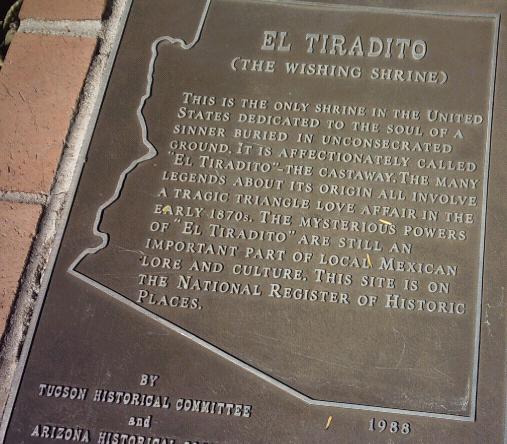
El Tiradito is an old shrine in Tucson, Arizona which is dedicated to an adulterer who was murdered by his lover’s husband. According to the official version of the story, El Tiradito was a young man named Juan Olivieras who lived in Arizona during the late 1800’s. He grew attracted to his mother-in-law who lived in what is now Downtown Tucson, and one day his lust led him to sleep with her.

However, this adulterated love wasn’t meant to last. One day, Juan’s father-in-law walked in on his unfaithful wife and Juan making love in their house. Hatred and rage soon engulfed the man as he watched his marriage get desecrated by his back stabbing son-in-law. Full of anger, the man grabbed a nearby axe and killed Juan.

After coming to terms with what he had done, the father-in-law fled south to Mexico. As for Juan, he was buried on the spot where he was murdered, in accordance with an old Mexican custom. A shrine was built over his grave, which is known today as the Wishing Shrine.


According to the legend, if you light a candle at the shrine and the candle stays lit until dawn, your wish will be answered. Many people pray for worldly possessions, which the shrine ignores. A prayer will usually be answered if it involves good health, forgiveness for a sinner, or finding love.

Unfortunately to the disappointment of many, a candle rarely stays lit. Some individuals have devoted many a night over the years praying at the shrine only to have their prayers ignored. This kind of rejection can destroy a person’s spirit. Despair can cause some people to do grave things.

According to the book Arizona Twilight Tales, by Jane Eppinga, there was once a woman named Amilia who was in love with a man named Juan Mario. One day, she discovered that Juan was married and had 3 children. Not sure of what to do, Amilia decided to pray at the shrine for Juan to leave his wife so that she could finally be with him. But her candles never lasted till sunrise.

Feeling frustrated, Amilia gave up after a while, and, in her despair, turned to the devil for help. She performed a voodoo ritual in which she took the remains of one of her old candles and formed it into the crude shape of a man. Then, after offering a prayer to the devil, stuck the effigy with needles and buried it. After realizing the grave consequences for her actions, Amilia abandoned the shrine and disappeared. Juan Mario was supposedly found dead of a heart attack soon after.

The superstitions and history surrounding this shrine have made it a very famous historical landmark, one definitely worth checking out if you have the time.

The shrine is located behind the parking lot of the El Minuto Cafe on Main St. just south of Cushing St. in Tucson.

Thursday, January 12, 2006

Gelatin Cake Recipe
by Chuck and Victor

This recipe, with slight modifications, was obtained from a neighborhood child care provider affectionally known as "Grandma Wanda" by the children. She was one of the child care providers who took care of Victor and his brother, David, during the day when they were young and we were at work. She made this cake one day while our family was visiting her, and Victor liked and later asked me to ask her for the recipe. This was added to our recipe collection and is now made periodically by Victor. Enjoy!


2 Small Packages Black Cherry gelatin desert (Jello or store brand)
1 Small Package Orange gelatin desert (Jello or store brand)
1 Small Package Lime gelatin desert (Jello or store brand)

Mix each flavor separately, omitting ½ cup of water on each package.

Let them set overnight in shallow pans.

Cut into ¾ inch or 1 inch cubes.

2 Small Packages Lemon gelatin desert (Jello or store brand)
2 Tablespoons Sugar
2 ½ Cups Pineapple Juice

Mix sugar & juice. Heat and mix in lemon gelatin desert (Jello or store brand). Chill in bowl until it begins to thicken.

Fold in 12 oz Cool Whip. Now fold in gelatin cubes & pour into bunt pan
or cake pan & chill for ½ a day.

Wednesday, January 11, 2006

SEAN GOES TO THE BEACH
by Chuck and Victor

Copyright © 1993, 2006 Charles J. & Victor L. Nugent


Once upon a time, when Sean the Leprechaun was a wee tike, he and
his Dad visited a tropical beach in Honduras. While they were on the
beach Sean saw a lady walking very erect and carrying a load of coconuts in the hat resting on her head. As she passed, bathers, sunning themselves on the beach, would call her over and buy one or two of her coconuts.

Upon seeing this, the wee little Sean pointed to the coconuts and
said excitedly, "Cocos Da! Cocos Da!" Seeing him the lady came over to them and his Dad brought two coconuts.

The lady removed two coconuts from her had and deftly sliced the top off the top of each coconut with her machete. Bending her knees while keeping her head and back perfectly straight, she handed one coconut to Sean and one to his Dad. While his father was paying the lady, Sean quickly dug into his coconut with his sand covered little fingers. Eagerly he scooped up the creamy meat and offered some to his Dad. His eager smile of anticipation was such that his Dad, setting aside sanitary concerns, graciously accepted the now gritty and slightly brownish treat.

Despite the look and feel of it in his mouth, The rich, creamy coconut meat tasted very good. Having sampled the first offering, his father was able to decline additional samples from the little tike. But that didn't matter as Sean eagerly drank the sweet milk and devoured the remaining meat - sand and all!

After consuming their little treat, they both strolled into the cool surf and continue d to splash and play in the waves.

Tuesday, January 10, 2006

The Talking Dog

Here is a joke that I received in an email the other day. It is an old one in that it has been around for a while making the rounds of the workplace. People used to type things like this up, then photocopy them and pass them around to friends and co-workers. Now days they just email the story to their co-workers and friends who, in turn, forward the email to their list of friends. After a while not only has everyone seen it a dozen times or so but the header information from all the forwarding takes up a dozen or more pages in the email.


A guy is driving through Alabama and sees a sign in front of a house
that reads, "Talking Dog For Sale." He rings the bell to inquire and
the owner tells him the dog is in the backyard. The guy goes into the
backyard and sees a Labrador Retriever sitting there.

"You talk?" he asks.

"Yep," the Lab replies.

"So, what's your story?"

The Lab looks up and says, "Well, I discovered that I could talk when I
was pretty young. I wanted to help the government, so I told the CIA
about my gift, and in no time at all they had me jetting from country
to country, sitting in rooms with spies and world leaders, because no one figured a dog would be eavesdropping. I was one of their most valuable spies for eight years running."

"But the jetting around really tired me out, and I knew I wasn't
getting any younger so I decided to settle down. I signed up for a job at the airport to do some undercover security wandering near suspicious
characters and listen in. I uncovered some incredible dealings and was
awarded a batch of medals."

"I got married, had a mess of puppies, and now I'm just retired."

The guy is amazed. He goes back in and asks the owner what he wants for
the dog.

"Ten dollars," the guy says.

"Ten dollars? This dog is amazing. Why on earth are you selling him so
cheap?"

"Because he's a liar. He never did any of that stuff."

Monday, January 09, 2006

A Profitable Sunday Morning at The Tucson Home Show
by Chuck


View of the Show


This past Sunday morning my wife and I attended the Tucson Home Show at the Convention Center in Tucson. I normally don't go to these shows, but Victor had volunteered to manage a booth for the Ki Center Martial Arts, where he has been active for years, and had two free passes for us.


Victor in his booth


We got Victor to the Convention Center in time for the 9:30 opening of the show for the day. The parking lot was almost full when we arrived and I was surprised by the large number of visitors who were there at that time on a Sunday morning. We had intended to just take a quick look around and leave. However, we ended up spending almost four hours at the show which occupied both the ground floor exhibition hall and a large upstairs ballroom.

The thing that both surprised me and resulted in our spending so much time at the show were the large number of timeshare vendors. These vendors had large booths with big banners that read Register to Win a $500 Home Depot Gift Card or something similar. Having worked trade shows myself, I know that the purpose of these giveaways is to collect names and contact information in order to try to sell something later. One look at the entry form and I knew, without even reading the fine print, that they were collecting information for a timeshare solicitation. So, I backed off, but Bella, my wife, wanted to try for the prize so, after warning her about the telephone calls she would be receiving, I stood by as she signed up.

I have attended a number of timeshare presentations in the past mainly to get the free gift. But I also had a secondary objective and that was to explore and understand this market with the intent of eventually buying. Early last month, Bella and I attended one in Sedona, Arizona where we did purchase a one-week timeshare with which we are very satisfied.

As soon as Bella began filling out the contest entry form a sales rep came over and began trying to schedule an appointment. I tried to blow off the rep by saying that we recently purchased a timeshare and were not in the market for another at this time. However, rather than backing off, this only encouraged the rep to push harder for the appointment. When he promised a $175 gas gift card and a week's free stay at their resort in Hawaii, I accepted.

We then proceeded to fill out the contest entry form for three other timeshare companies where, in addition to a number of other freebies, which are nice but nothing I felt were worth investing a lot of time obtaining, I obtained promises of a $50 Costco gift card, a $100 Visa gift card, a $20 gas voucher, $10 in cash and 10,000 hotel rewards points (which can be used for airline fares, car rentals, etc. and don't expire). I did not have to negotiate for these, but rather let them give me their quick pitch and then choose the gifts I wanted from the list they presented to me. Since we are planning to vacation in Hawaii this summer using the one week timeshare that we have already purchased, the promise of an additional five days lodging for free was attractive. Since the gift cards can be used for things we normally purchase anyway, we can put what we would normally spend on these things away for our airfare to Hawaii.

Now, I will have to attend a 90 minute sales presentation at each one of these places and, I know from past experience, that they have very good sales reps who will make very attractive offers which will only be available if I purchase at the sales presentation. However, I will counter by pointing out that, first I have just purchased a time share and want to finish paying for that before I buy any more and, second, with two children in college and two more getting ready to go to college we do not feel we can afford an additional time share investment at this time.

I made it very clear to each sales rep that I am not ready to buy additional timeshares at this time for the reasons stated above. But they insisted that they wanted me to attend anyway. They stressed that there was no obligation and produced as many inducements as they could to get me to attend. Why?

First, the sales reps at the Home Show will receive a commission for every qualified prospect they register for a sales presentation. Whether I buy or not, they will receive their commission SO LONG AS I ACTUALLY ATTEND THE SALES PRESENTATION. Another sales rep will give the presentation and that sales rep will receive a commission only if I make a purchase.

Second, the companies know that many of the people attending these sales presentations will not purchase. But they give away lavish gifts anyway, because even when people do not make a purchase, they usually come away sufficiently impressed with the concept to both begin thinking about it for the future and, more importantly for the company, telling their friends about it. At these presentations, whether you buy or not, they not only ask you to tell your friends but also ask for names and addresses of friends and family whom they can solicit for future sales presentations.

Third, the timeshare industry is not that well known and information about it cannot be easily distilled conveyed in a 30 second TV spot. Most people are not going to research and educate themselves about it on their own and, in the absence of knowledge about the product, people are not going to buy it. So these companies need the opportunity to educate the public about the industry.

Finally, while the incentives they provide are valuable to me, I am fairly certain that the time share companies are not paying any where near the price that I would have to pay for the same item. Obviously, a five day stay at a luxury resort in Hawaii would cost me $200 or more per night. But, so long as there are vacancies (which there are, otherwise the companies would not be selling timeshare interests for the resort) it will cost them next to nothing to let my family an me use the room in exchange for the opportunity to sell me a ten or twenty thousand dollar timeshare. Similarly with the gift cards. A $175 gas card would cost me, as an individual, $175. But not only would the timeshare company get a discount for purchasing in bulk but would also probably reduce the price further by paying part in cash and part in rooms and conference facilities. Again, if they are not fully booked, the cost to the resort would be next to nothing but the Mobil Corporation or Costco Corporation could use them for sales and other meetings as well as give them away as incentives to employees. It is a win-win for everyone.


Model Train Club Exhibit

Sunday, January 08, 2006

The Arrival of the Magi
by Chuck

The following is the account of the arrival of the Magi as recorded in Chapter 2 of the Gospel of St. Matthew. (Source: "The New American Bible, Thomas Nelson Publishers, 1983, pages 1049 - 1050)


The Astrologers. After Jesus' birth in Bethlehem of Judea during the reign of King Herod, astrologers from the east arrived one day in Jerusalem inquiring "Where is the newborn king of the Jews? We observed his star at its rising and have come to pay him homage." At this news King Herod became greatly disturbed, and with him all Jerusalem. Summoning all of the chief priests and scribes of the people, he inquired of them where the Messiah was to be born. "In Bethlehem of Judea," they informed him. "Here is what the prophet has written:

'And you, Bethlehem, land of Judah,
are by no means least among the
princes of Judah,
since from you shall come a ruler
who is to shepherd my people Israel.'"


Herod called the astrologers aside and found out from them the exact time of the star's appearance. Then he sent them to Bethlehem, after having instructed them: "Go and get detailed information about the child. When you have found him, report it to me so that I may go and offer him homage too."

After their audience with the king, they set out. The star which they had observed at its rising went ahead of them until it came to a standstill over the place where the child was. They were overjoyed at seeing the star, and on entering the house, found the child with Mary his mother. They prostrated themselves and did him homage. Then they opened their coffers and presented him with gifts of gold, frankincense and myrrh.

They received a message in a dream not to return to Herod, so they went back to their own country by another route.

Thursday, January 05, 2006

On the TwelfthDay of Christmas...Twelve Drummers Drumming
by Chuck

Christmas E-Cards

On the twelfth day of Christmas,
my true love sent to me
Twelve drummers drumming,
Eleven pipers piping,
Ten lords a-leaping,
Nine ladies dancing,
Eight maids a-milking,
Seven swans a-swimming,
Six geese a-laying,
Five golden rings,
Four calling birds,
Three French hens,
Two turtle doves,
And a partridge in a pear tree!


We have now reached the end of the song and have arrived at the last day of Christmas known as Twelfth Night on which the partying and feasting continued. Twelfth Night is the night before Epiphany which is the day the three Wise Men, also known as the Three Kings or Magi, from the East arrived in Bethlehem bringing gifts to the Christ child.

By the Middle Ages the drum, which was probably introduced to Europe from the Middle East by knights returning from the Crusades, had become a common instrument. Among its other uses was to combine it with the trumpet and used to get people's attention when making a big announcement such as the arrival of the king or the reading of an important proclamation. In this case the drum was used to announce the serving of the next course of the feast.

Among other customs in England as well as France and other West European countries was the making and serving of a special Kings' Cake for this twelfth night celebration (the practice of making and serving a special King's Cake survives today in the U.S. as a part of the Mardi Gras celebrations.

Our song and twelve day celebration has come to an end. But it is not the end of the season. For tomorrow is the Feast of the Epiphany, another religious holiday associated with Christmas. While mainly just a religious observance in the U.S., Epiphany is also a day of both religious and secular celebrating in other countries.

While the solstice has passed and the days are slowly beginning to lengthen again, winter still holds the land in its grip. The work of the peasant and noble is light as it is still too early to begin planting and the cold and continuing short days remain an incentive to stay inside and party. So the party season will continue, with Epiphany tomorrow and continuing through the season of Mardi Gras up until Fat Tuesday, the day before Ash Wednesday and the start of the Lenten season.


Copyright © 2005-2006 by Charles J. Nugent Jr. and Victor L. Nugent.

Wednesday, January 04, 2006

On the Eleventh Day of Christmas...Eleven Pipers Piping
by Chuck

Christmas E-Cards

On the eleventh day of Christmas,
my true love sent to me
Eleven pipers piping,
Ten lords a-leaping,
Nine ladies dancing,
Eight maids a-milking,
Seven swans a-swimming,
Six geese a-laying,
Five golden rings,
Four calling birds,
Three French hens,
Two turtle doves,
And a partridge in a pear tree.


At the big feasts held during the holiday celebrations the guests were often entertained by musicians, dancers, jugglers, etc. as well as singing and dancing themselves. Bagpipes and their younger cousins the musette (an instrument similar to a bagpipe but the air for the sound came from bellows rather than blowing into the instrument) were a popular instrument for dance music. While we usually associate the bagpipe with Scotland, they were also a common instrument in France as well. Since Queen Elizabeth I was succeeded by the Stuart kings of Scotland, bagpipes and other aspects of Scots culture were common among the upper classes in England as were elements of French culture due to intermarriage of the English and French nobility.

The pipers referred to in the song would be the professional bagpipe musicians hired to entertain the guests with their music and provide music for dancing.

Today, I am presenting a humorous take off on The Twelve Days of Christmas. This song obviously lends itself to gags like this and the invention of the photocopier and later the computer make it easy to produce and distribute things like this. They are especially popular in the workplace where access to copiers and computers make them easy to create and reproduce as well as pass around to the large number of people at the work site.

I think I first saw one of these gag versions of the song when I was in high school and my uncle brought a copy from work to a family gathering. This one was tame enough for both mixed company as well as older children (younger ones wouldn't have understood it). Later, when I entered the workforce versions of this would appear in the office at Christmas time – some were rather tame like this one while others were more risqué. Of course with the advent of the computer, email and the Internet these are quite common – if you want to see more versions just go to the Internet and do a search.

In addition to providing a humorous interlude in the series this is also a good example of how the song could have developed in the days before the printing press. Unlike today, when there is basically one version of the carol, there were many. The carol varied from village to village and grew and changed as it was passed from one village or group of people to the next. Some changes were simple misinterpretations of what someone heard in another village while others took liberties and made changes to what had been passed on. In an environment like this it is easy to see how the carol could evolve and grow.

Here is one version of a humorous take off on The Twelve Days of Christmas.

On the first day of Christmas...

Ms Sarah FitzPatrick
131 Love Lane
Why, AZ


December 25, 2004

Dearest Tim:

I went to the door today and the postman delivered a partridge in a pear tree. What a thoroughly
delightful gift. I couldn't have been more surprised.

With deepest love and devotion,

Sarah

On the second day of Christmas...

Ms Sarah FitzPatrick
131 Love Lane
Why, AZ


December 26, 2004

Dearest Tim:

Today the postman brought your very sweet gift. Just imagine two turtle doves. I'm just delighted at your very thoughtful gift. They are just adorable.

All my love,

Sarah

On the third day of Christmas...

Ms Sarah FitzPatrick
131 Love Lane
Why, AZ


December 27, 2004

Dearest Tim:

Oh! Aren't you the extravagant one. Now I really must protest. I don't deserve such generosity. Three French hens. They are just darling but I must insist, you've been too kind.

Love,

Sarah

On the fourth day of Christmas...

Ms Sarah FitzPatrick
131 Love Lane
Why, AZ


December 28, 2004

Dear Tim,

Today the postman delivered 4 calling birds. Now really, they are beautiful but don't you think enough is enough. You're being too romantic.

Affectionately,

Sarah

On the fifth day of Christmas...

Ms Sarah FitzPatrick
131 Love Lane
Why, AZ


December 29, 2004

Dearest Tim:

What a surprise. Today the postman delivered 5 golden rings; one for every finger. You're just impossible, but I love it. Frankly, all those birds squawking were beginning to get on my nerves.

All my love,

Sarah

On the sixth day of Christmas...

Ms Sarah FitzPatrick
131 Love Lane
Why, AZ


December 30, 2004

Dear Tim:

When I opened the door there were actually 6 geese a-laying on my front steps. So, you're back to the birds again, huh? Those geese are huge. Where will I ever keep them? The neighbors are complaining and I can't sleep through the racket.

Please stop.

Cordially,

Sarah

On the seventh day of Christmas...

Ms Sarah FitzPatrick
131 Love Lane
Why, AZ


December 31, 2004

Tim:

What's with you and those crazy birds? 7 swans a-swimming. What kind of terrible joke is this? There're bird droppings all over the house, and they never stop with the racket. I can't sleep at night and I'm a nervous wreck. It's not funny. So stop sending me all these birds!

Sincerely,

Sarah

On the eighth day of Christmas...

Ms Sarah FitzPatrick
131 Love Lane
Why, AZ


January 1, 2005

O.K. Buster:

I think I prefer the birds. What am I going to do with 8 maids a-milking? It's not enough with all those birds and 8 maids a-milking, but they had to bring their cows! There is manure all over the lawn and I can't move in my own house. Just lay off me, wise guy.

Sarah

On the ninth day of Christmas...

Ms Sarah FitzPatrick
131 Love Lane
Why, AZ


January 2, 2005

Hey! Stupid,

What are you? Some kind of sadist? Now there's 9 ladies dancing. They have been dancing constantly since they arrived yesterday morning. The house is in total chaos. They cows are getting upset,
and they're stepping all over those screeching birds. What am I going to do? The neighbors have
started a petition to evict me.

You'll get yours,

Sarah

On the tenth day of Christmas...

Ms Sarah FitzPatrick
131 Love Lane
Why, AZ


January 3, 2005

You Rotten Sadist,

Now there's 10 lords a-leaping. What little was left of my house has now been smashed as the lords have been leaping everywhere as they chase after the maids and ladies. Worse, the cows can't sleep and they've got the diarrhea. My living room is a river of manure. The commissioner of Buildings has subpoenaed me to give cause why this building shouldn't be condemned.

I'm sending the police after you.

One who means it.

On the eleventh day of Christmas...

Ms Sarah FitzPatrick
131 Love Lane
Why, AZ


January 4, 2005

Listen! Looser,

Now there's eleven pipers piping. And they never stop piping except when they're chasing those maids or dancing girls. The cows are getting very upset and are sounding worse than the birds ever did. What am I going to do? There is a petition going around to evict me from the neighborhood.

I hope you're satisfied, you rotten, vicious swine.


Your sworn enemy,

Sarah

On the twelfth day of Christmas...

Law Offices
Sue, Pillage, and Plunder
303 Knave Street
Los Angeles, CA


January 5, 2005

Dear Sir:

This is to acknowledge your latest gift of 12 drummers drumming which you have seen fit to inflict on our client, Ms Sarah FitzPatrick. The destruction, of course, was total. All correspondence should come to our attention. If you should attempt to reach Ms FitzPatrick at Happy Dale Sanitarium, the attendants have instructions to shoot you on sight. With this letter please find attached warrant for your arrest.

Cordially,

Sue, Pillage, and Plunder


Copyright © 2005-2006 by Charles J. Nugent Jr. and Victor L. Nugent.

Tuesday, January 03, 2006

On the Tenth Day of Christmas...Ten Lords A-Leaping
by Chuck

Christmas E-Cards

On the tenth day of Christmas,
my true love sent to me
Ten lords a-leaping,
Nine ladies dancing,
Eight maids a-milking,
Seven swans a-swimming,
Six geese a-laying,
Five golden rings,
Four calling birds,
Three French hens,
Two turtle doves,
And a partridge in a pear tree.


The ten lords a-leaping most likely refers to leaping dancers (called morris dancers) who performed leaping dances between courses at feasts. This type of wild and strenuous dancing probably evolved from more ancient war and fertility dances and would have been a popular form of entertainment for this type of function. Unlike the nine ladies dancing in the previous stanza where the dancers appear to have been guests dancing for enjoyment, these were professional dancers brought in to entertain the guests while they dined.

In yesterday's entry I made reference to an article by Fr. Hal Stockert, a Roman Catholic priest and author, in which he claimed that evidence he found indicated that The Twelve Days of Christmas had been created by Catholics in England as a code to secretly educate their children in the Roman Catholic faith during a period when the practice of the Catholic religion was illegal in Britain. While I am still trying to find Fr. Stockert's original article as well as determine whether it was originally published in print, on the Internet or both, basic facts of Fr. Stockert's thesis are outlined below.

While doing research in the British Isles in late 1970s or early 1980s on a topic totally unrelated to The Twelve Days of Christmas, Fr. Stockert came across references in old letters and reports to parent's using the The Twelve Days of Christmas as a code to teach their children the basic tenants of the Catholic faith. In Origin of the Twelve Days of Christmas http://www.catholicculture.org/lit/activities/view.cfm?id=540 Fr. Stockert states that these references to the carol were made in passing in the letters and articles and were not the main topic of the letters or reports. He also states that the references he found were in letters and reports by Irish Jesuit priests to their superiors in France. Fr. Stockert admits that he did not follow up and research the topic but, finding the information interesting, he made notes of these entries. After he completed and published his original research, he wrote and published a short article about The Twelve Days of Christmas being a code used by persecuted Catholics in England and included historical background about the laws and official persecutions (including executions) of Catholics in England during this period. By his own admission, the article was based on bits of information that was not thoroughly researched and was presented solely as an item of interest or suggestion for future research by someone else.

Fans and critics alike have jumped on this and thousands of web pages have been devoted to discussing, praising and criticizing the idea of religious symbolism in The Twelve Days of Christmas. Fr. Stockert has been harshly criticized for sloppy research and not having the facts to back up his claims. This charge of poor research is reinforced by the fact that Fr. Stockert's written notes on this subject were, according to Fr. Stockert, destroyed when a water pipe in the ceiling above the room containing the notes broke and the room flooded. Further, information he originally published on the Internet was posted on a message board of some sort in a format that is no longer readable. Fate has thus made it appear that his article was pure fiction.

While I reject Fr. Stockert's thesis for reasons explained below, I believe that he is a very good scholar and that his intentions were to provide a thought provoking piece for someone else to research more fully and prove or disprove. As to his notes, I believe that they existed and were destroyed as he described – throughout history tons of documents have been lost due to fire, flood, crumbled with age, etc. As to the notes or information published on-line by Fr. Stockert in 1982 these probably are unreadable. The Internet itself did not become available to the public (it was originally a military project) until the first Bush Administration, following the end of the Cold War, made it available to the general public. The World Wide Web, which most of think of when we hear the term Internet was not created until 1994. Prior to the Internet there existed bulletin boards and various other message type boards on line which information could be exchanged and posted. While the boards still exist the computer code used to generate them is often unreadable as are many things created with older DOS based word processors. The rapid development of computer technology has left behind a large amount of material that currently is not readable using present day computers and software.

From its earliest years to the present the Church has often been forced to operate underground in order to survive. Pope John Paul II ran such a church in Poland prior to his ascent to the Papacy. Other religions have had to operate underground as well. In the Southwestern U.S. there is the four hundred year old story of the Crypto-Jews http://parentseyes.arizona.edu/bloom/sjhart.htm (also known as Marranos, Conversos and hidden Jews) who had been forcefully converted to Catholicism in Spain during the Inquisition but had secretly kept their Jewish faith alive from generation to generation in the Spanish colonies where they had sought refuge from persecution.

In England from 1558 to 1829 it was illegal to be a Catholic or practice the Catholic faith. Priests especially, but members of the Catholic Church in general as well, were arrested and executed, often in a very barbaric manner, for practicing their faith. In Ireland the persecution was conducted with even more zeal. These are documented historical facts and do not need Fr. Stockert's research to support them.

However, the laws and persecutions were limited to a few periods between the years 1558 and 1829. The laws remained on the books but were usually not enforced which enabled Catholics to practice their faith openly. The periods when the Church was forced to operate underground coincided with the era of Queen Elizabeth I and her Stewart successors in which rival claimants to the throne of England, aided by unfriendly foreign governments, sought to forcibly remove the reigning British monarch. Religion was a factor in these disputes but politics and power were the driving force. The references that Fr. Stockert gives http://www.catholicculture.org/lit/activities/view.cfm?id=540 refer to correspondence between Jesuit priests in Ireland with their superiors in France. The Jesuits were a powerful order and often involved in politics. Their vast world-wide network of highly educated and motivated priests was a good source of intelligence which leaders of the order exchanged for increased wealth and power for the order. I am not arguing here whether this was good or bad – it is a fact and for this reason the Jesuits were both used and feared by secular rulers. It is therefore understandable that the British monarchs saw the Jesuits as a serious threat. At various times the Catholic monarchs of France and Spain also went after the Jesuit order despite their common Catholic faith (the old Spanish mission church, San Xavier del Bac http://www.sanxaviermission.org/ in Tucson was founded by the Jesuits but later transferred to the Franciscans when the King of Spain issued an order expelling the Jesuits from Spain and all of its dominions). One need look no farther than the founding of the state of Maryland to see evidence of the lack of enforcement of the anti-Catholic laws. George Calvert, the first Lord Baltimore, was Secretary of State to King James I (successor to Queen Elizabeth I). In 1625 he left public life and practiced his Catholic faith openly. Not only was he not arrested but, in return for his previous service, King James awarded him with a large grant of land in Newfoundland where Calvert attempted to establish a colony. Finding the climate and conditions in Newfoundland too harsh for their plans, Calvert and his son, Cecil Calvert (1606 – 1675), the second Lord Baltimore, petitioned James' son, King Charles I for a second land grant further south and were given the land that is now the State of Maryland. In establishing his colony in Maryland, Cecil Calvert decreed that there would be a separation of church and state and Christians (his freedom of religion did not extend to Jews and other non-Christians) of any denomination were free to worship as they pleased. http://www.baltimoremd.com/monuments/lordbalt.html Here we have two English kings who not only tolerated the open practice of the Catholic faith by a lord of the realm but rewarded him with land grants and stood by as he used the land received to establish a haven for Catholic and other non-Anglican Christians (Puritans and other non-conformist creeds were outlawed along with Catholics during this period.) The fact that the active persecution of Catholics was limited in terms of time is one reason for believing that Catholics would not go to the trouble of investing a secular song with a coded religious message.

A second and, more compelling reason is the fact that, with the possible exception of the seven sacraments, none of the coded teachings in the song were illegal. Both the Roman Catholic and the Anglican (Church of England) shared these beliefs. Teaching a child about the Old and New Testament, the Four Gospels, the Apostle's Creed, etc. was not a way to identify a person as Roman Catholic since Anglican parents taught their children the same articles of faith. I am a practicing Roman Catholic. My father's side of the family were Irish Catholics and I was raised in that religion. However, my Mother's side of the family were Irish Protestants (Presbyterian) from Ulster (Northern Ireland) and my Mother has been an active member of the Episcopal (the American branch of the Anglican Church) since her youth. I have thus, grown up with both churches and have attended mass in both churches. When I attend church with my Mother I have no problem following the mass and responding from memory with the rest of the congregation as the ritual of the mass is essentially the same as that of the Catholic Church. Other than the fact that the current pastor of the church my Mother attends is a woman, there is very little difference between the mass at her church and my own Roman Catholic parish church. My father used to tell a story about a Catholic priest whose big desire in life was to celebrate mass in St. Patrick's Cathedral in New York City. Given the opportunity to visit New York City, the priest went straight to St. Patrick's Cathedral http://www.fordham.edu/halsall/medny/stpat1.html on Fifth Avenue. Arriving just before the morning mass, the priest introduced himself to the priest who was about to celebrate mass and, after telling him of his desire to celebrate mass in this church, asked if he could celebrate the mass with him. Seeing the man's great desire the pastor stepped aside and let the out-of-town priest celebrate the mass. Everything went fine and the priest left the church filled with happiness. On the street outside he bumped into an acquaintance and, pointing to the church he had just exited, excitedly described the joy of having celebrated mass in St. Patrick's. When he finished, his friend had a puzzled look on his face and said, St. Patrick's is across the street. This is St. Thomas Church. http://www.saintthomaschurch.org/ You just celebrated mass in a Protestant Church!

Is the carol The Twelve Days of Christmas really a code used by persecuted Roman Catholics in the British Isles to teach their children the faith? I think not. Did some Catholics use this carol to secretly teach the faith to their children? Given the large number of Catholics, their differing circumstances, and the varying degrees of enthusiasm of the local officials charged with enforcing the anti-Catholic laws it is possible that some did use the carol for this purpose. If someone were to make a serious attempt to uncover the letters and reports that Fr. Stockert found and then dig further they might discover isolated instances where the carol was used for this purpose. Until then, we have to accept the fact that a theory has been put forward and no one has as yet come forward with hard evidence to prove or disprove it.


Copyright © 2005-2006 by Charles J. Nugent Jr. and Victor L. Nugent.